

Connect Perforce P4 with Your Favorite Tools
P4 integrates with your favorite 3rd party tools to automate your workflows and grow your business. This page highlights the most popular and loved integrations. For a full list of available integrations, click here.
Unreal Engine and Unity Integration by ICVR
As an official partner of Unreal Engine and Perforce, ICVR develops, automates, and deploys real-time pipelines for award-winning projects. ICVR is also an expert in Blender, Flow Production Tracking, and more. With ICVR’s full-service support and technology, you can give your creative teams more time to focus on their craft.

Game Engines
Integrate P4 with the most widely used game engines so that users never have to leave the comfort of their familiar environment to version digital assets.
Unreal Engine
Version files and assets seamlessly within engine, and gain access to exclusive features like Horde and Unreal Game Sync.
Unity
Submit changes directly in Unity while leveraging P4's enterprise-grade scalability and performance with this built-in extension.
Crytek: CRYENGINE
Check out or overwrite files directly within CRYENGINE’s Sandbox Editor with this plugin and configurations.
Integrated Development Environments (IDEs)
Integrate P4 with your preferred IDE to boost productivity while maintaining a single source of truth.
Microsoft Visual Studio
Add, edit, and revert files without leaving Visual Studio with this powerful connection to Perforce P4.
Rider
Manage all of your Microsoft development assets with full P4 version control support—no manual setup required.
IntelliJ IDEA
Connect P4 to IntelliJ to access exclusive checkout, version history, and project status without leaving your environment.
Eclipse Plugin
Give Java developers access to all P4 version control features directly within Eclipse with regular plugin updates and support.
PyCharm
Provide Python developers with seamless version control to commit, sync, and track changes directly within PyCharm's interface.
Android Studio
Manage your Android digital assets with P4. With access to commit, sync, and manage changes directly in Android Studio.
CLion
Manage source code, libraries, and dependencies with the enterprise-class features of Perforce P4 and/or Klocwork.
CI/CD + Application Monitoring Tools
Integrate P4 with the most popular CI/CD and application monitoring tools to drive continuous delivery and optimization.
Jenkins
Run builds and automation across code and binaries stored in P4, while gaining the traceability P4 provides.
TeamCity
Pre-test and pre-build files in shelved P4 changelists. TeamCity can also post the results in P4 Code Review.
Sentry
Connect P4 and P4 Code Review for faster debugging with stack trace linking, commit tracking, and suspect commit detection.
Digital Content Creation Tools (DCC)
Simplify your creative workflows by connecting your favorite tools with P4 for smooth version control.
P4GT
Enable artists and designers to version within their preferred tools (including Adobe Photoshop, Autodesk 3ds Max, and Maya).
Houdini
Add or checkout files, submit (partial) changelists, scan for dependencies, and revert files all from within the Houdini menu.
Project Management Tools
Boost collaboration and project visibility by integrating P4 with your team’s favorite project management tools.
Jira
Sync work items and jobs to P4 and P4 Code Review, with automatic job creation and status updates across both tools.
Windows File Explorer
Access common tasks like check out, submit, view changelists, and more, from File Explorer's right-click menu.
Slack
Receive automated notifications in Slack channels when changes are committed or reviews are created in P4 Code Review.
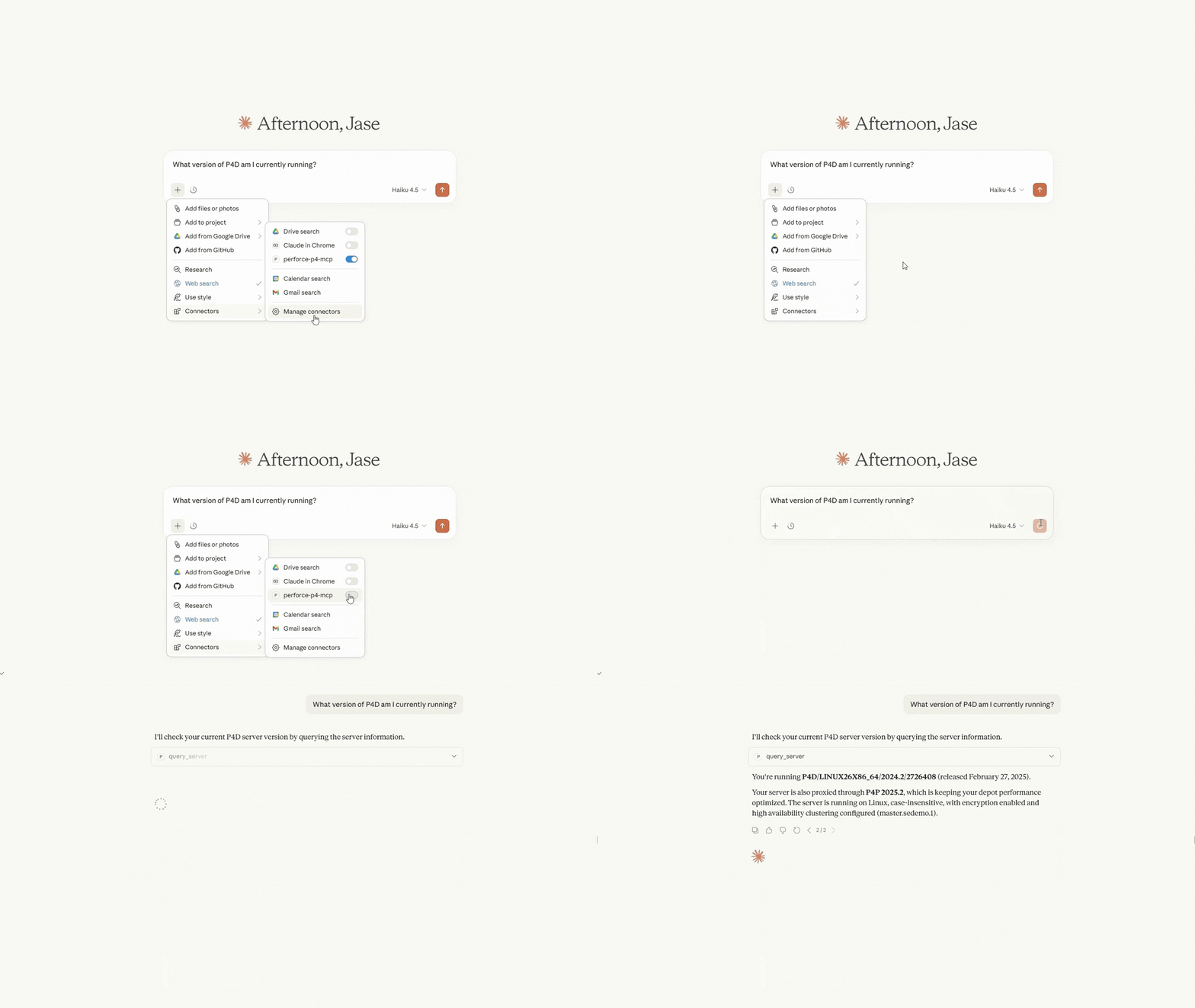
Your Intelligent System of Record with P4 MCP
Give your teams instant clarity into what’s happening across every project, including who changed what, when, and why, all inside the AI tools they already use (like ChatGPT and Claude).
Get Started with P4
If you don’t yet have P4, get started for free for up to 5 users and 20 workspaces.
Get Started with P4 Cloud
Get Perforce-managed and hosted version control for only $39/user/month.
We’re Here to Help
Get in touch with our experts. They’ll walk through solutions that work best for you and your team.