
Blog
November 23, 2026

Large enterprises will always have the option to build software themselves. When I was at HSBC, we had more developers than Microsoft. For a company of that size, creating internal solutions was always on the table.
But here’s the rub: just because you have the developers doesn’t mean you should build everything. When a project could take six months and cost $500,000 or more to build, the ROI of “do it yourself” drops significantly.
AI is changing that build-versus-buy decision, but not in the way many people think. It can make some complex tasks easier, but it doesn’t mean every project can be built with a few prompts.
Back to topWhat AI Software Is Worth Building In-House?
Some software is worth building because it’s cheap and easy, or only intended to exist for a short time. Other software is worth building because it’s unique to your business.
The Case for Disposable Software
Disposable software is code built quickly to solve an immediate problem, not to become permanent infrastructure. As software gets cheaper and faster to build, not everything we create needs to become permanent. Some of it can be disposable.
Think of it as the Keurig pod of software. It may not be that good, and it may not be great for the long term, but it’s cheap, convenient, and gets the job done.
There’s nothing wrong with that. Sometimes you just need something that solves the problem in front of you. If your team needs a simple connector between two systems, build it without turning it into a six-month project. But cheap isn’t the only reason to build.
Build What’s Bespoke to Your Business
For most enterprises, the best candidates to build in-house are agents, Model Context Protocol (MCP) servers for custom systems, job-specific frameworks, and workflows built around proprietary data and processes.
If you create your own agent, you can tailor it to your processes. If you train a model on a dataset unique to your company, that’s something competitors can’t buy off the shelf.
While some predicted every business would craft its own models for everything, it turns out general-purpose models work just fine for many tasks. The value is less about owning the model and more about what you build around it.
Related Reading → What Is an MCP? Breaking Down the Model Context Protocol
Back to topEasy to Build Doesn’t Equal Easy to Maintain AI Infrastructure
Connecting AI to a system is easy. But in an enterprise, that connection is just the start. You might only want AI to access certain parts of a system or API, allowing it to automate some actions while keeping others off-limits.
You need a secure foundation for authentication, access control, governance, and visibility while controlling who can access what and what they can do. At that point, you’re not just connecting systems. You’re also building infrastructure you have to maintain.
The technology’s changing quickly, too. Standards are still being established. MCP specifications have already shifted, creating hiccups, and they’ll likely shift again.
Many companies may start building their own solution and realize it’s more of an investment than they’re willing to make. We’ve seen this before with tech like OAuth. Teams built their own solutions, discovered how much additional maintenance they were taking on, and turned to providers like WorkOS.
Back to topBuild vs. Buy? Most Companies Do Both
It probably won’t be a choice between a fully in-house AI stack and one closed platform. Companies will, and do, use a combination of internal, commercial, open-source, and hyperscaler technology.
But this mix creates another problem: making it all work together. That’s the middle ground we’re exploring with Perforce Agentic Gateway.
Agentic Gateway started with a simple idea: If we put technology between an AI model and all the tools it could talk to, what useful things could we do there?
Customer feedback pointed us toward the next step. Enterprises liked what Agentic Gateway could do, but they wanted a centralized, deployable version with the controls they’d expect from enterprise software, including governance, access control, and a clearer view of what’s happening across their AI connections.
Governance matters, but it’s table stakes. A product that does nothing but governance probably isn’t enough. The value comes from what people can build once they know those connections are under control.
In one Agentic Gateway demo, we combined a BlazeMeter MCP server with information from the U.S. Geological Survey. We used the two sources to create a dashboard showing seismic risk around BlazeMeter load-generation locations.
The two systems were built without knowing anything about each other, but within a few minutes we could bring their information together and present something new in a consistent, cost-efficient manner.
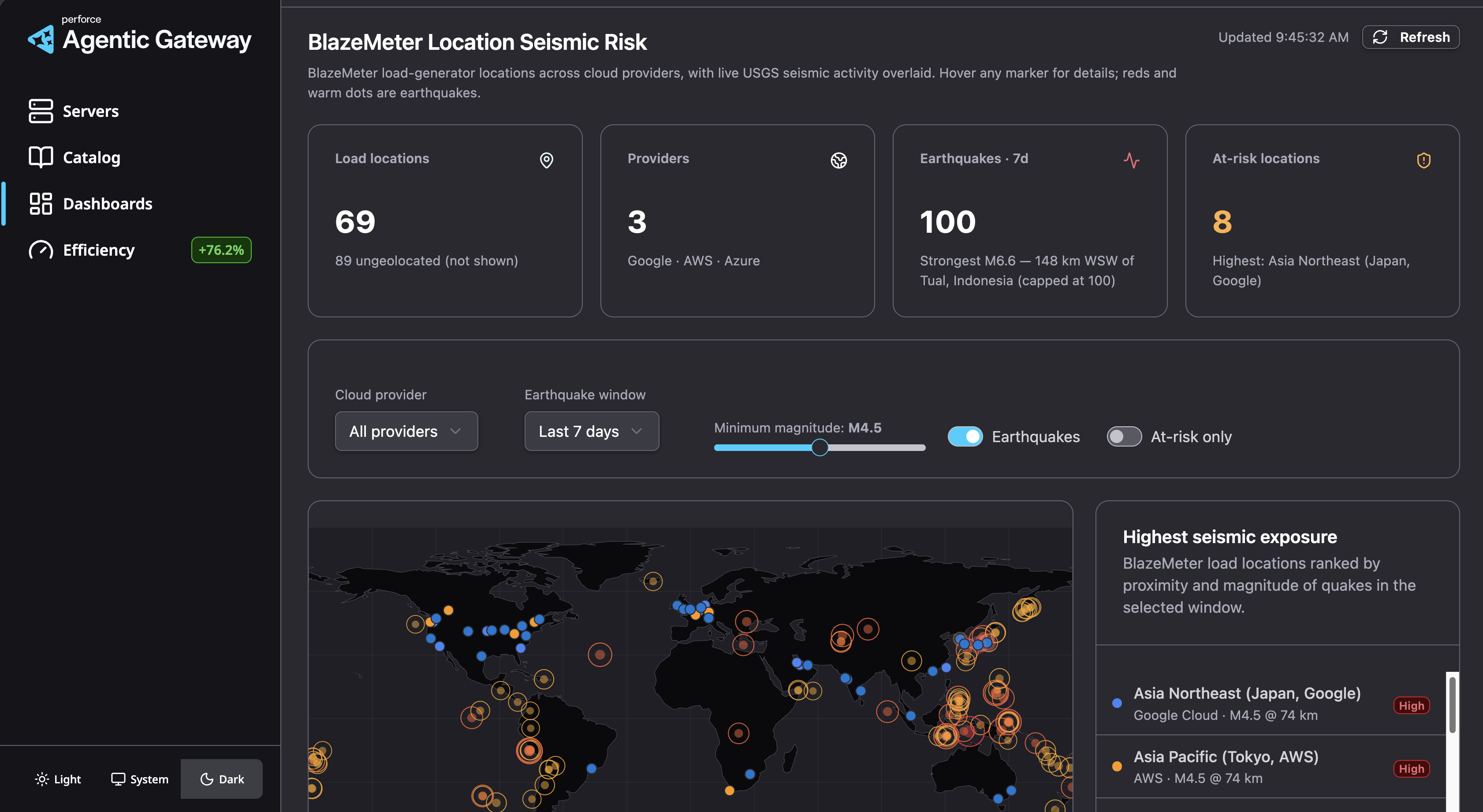
I don’t know how many customers need that exact dashboard. That wasn’t the point. The point was that we could combine two independent capabilities and create something that probably wouldn’t have existed otherwise.
Watch the Playlist → See Perforce Agentic Gateway in Action
Back to topAI Made Software Cheaper to Build, Not to Own
AI won’t end the build-versus-buy debate, but it will change what’s worth building.
Companies will build quick scripts and integrations because they’re cheap to create. Some will be disposable, and that’s fine. They’ll also build agents, workflows, and connections around their own systems and knowledge because that’s where they can create an advantage.
But the foundation underneath all of it is a different story. Once you build that yourself, you own everything that comes with it: security, access controls, governance, visibility, changing standards, and maintenance.
When software gets cheap, the value moves to what's unique to your business. There's plenty worth building yourself. The question is how much of the infrastructure underneath it you really want to own.
Do More With Your MCPs
Build what's unique to your business without owning all the infrastructure underneath it. See how Perforce Agentic Gateway brings Perforce and third-party MCPs together through one gateway, so teams can connect the tools they already use and build more on top of them.