
Guide
Evaluate Enterprise Synthetic Data: A Decision Maker’s Guide


Data Management,
DevOps,
AI
In our work with enterprise development and QA teams, we’ve seen what separates synthetic data that holds up in real testing from data that only looks realistic. This guide covers the capabilities we think matter most in a solution fit for enterprise use, how Delphix delivers on them, and a checklist of questions to ask any vendor.
Table of Contents
What is the Current Landscape of Synthetic Data Generation Tools?
Most synthetic data tools on the market today are legacy tools whose AI-powered features are bolted on rather than core to the product. They were built for slower release cycles, narrower scopes, and teams with deep database expertise but who are removed from the software development lifecycle.
Many of these tools are not prepared for AI-driven and agentic development. Agents write and run tests faster than people can, across many more scenarios. Keeping up takes data that is available on demand, consistent across systems, and repeatable from run to run. Most legacy tools weren’t designed for that pace or scale.
What Types of Synthetic Data Tools Are Available?
Most options fall into four groups, and each has a typical gap:
Legacy rules-based tools:
Teams define rules field by field and configure relationships by hand.
DIY scripts and fake-data libraries:
These work well for one application, but not in complex enterprise settings. Cross-system relationships and schema changes become engineering tickets, and general-purpose LLMs create data that is not deterministic, i.e. won’t maintain the referential integrity of data across systems. Scripts are time-consuming, and in our experience, it can take 4-10 developers to create and maintain synthetic data this way.
Standalone AI-driven generators:
Setup is easier. Many still depend on an LLM at generation time and work on one database at a time.
Entity-based data platforms:
They can keep data connected across systems, but they need significant modeling before the first dataset. These tools tend to be made for analytical and BI use cases rather than development and testing.
Delphix Synthetic Data is a new generation of solutions that takes a different approach. AI is core to discovery and configuration, generation runs on governed rules, and developers and agents can request data on-demand.
What do Enterprise Leaders Say About Legacy Synthetic Data Tools?
We asked 518 enterprise leaders how well the synthetic data solutions that were available in early 2026 met their needs. The results match what we have heard in the field:
- Only 34% said synthetic data provides referential integrity.
- Only 36% said it provides data realism.
- 66% of software leaders said their organizations don’t use synthetic data in development and testing.
(From The Synthetic Data Market Gap: Findings from our 2026 Survey)
We developed Delphix Synthetic Data — which entered general availability in September 2026 — to close this gap by providing realistic, scenario-specific data that preserves relationships across systems and is available at agentic development speed.

10 Capabilities to Look for in Enterprise Synthetic Data
Referential integrity matters in synthetic data because enterprise applications span multiple databases. Test data has to reflect the connections between those systems.
- Data that looks right in each system can quietly break across systems.
- It may load without errors, then cause test failures that have nothing to do with your code.
- Integration and end-to-end tests lose their meaning.
- Teams building new applications may not uncover integration issues until late in the development cycle.
Look for a solution that keeps data connected across all your systems, not just within one database. Ask whether it can:
- Preserve relationships across database boundaries, not just within a single schema.
- Generate in dependency order, parents before children, in a single pass across all connected systems.
- Work with tables that already contain data, not only clean, empty environments.
- Handle schema changes without manual reconfiguration.
- Keep masked production data and synthetic data consistent when they coexist in the same environment.
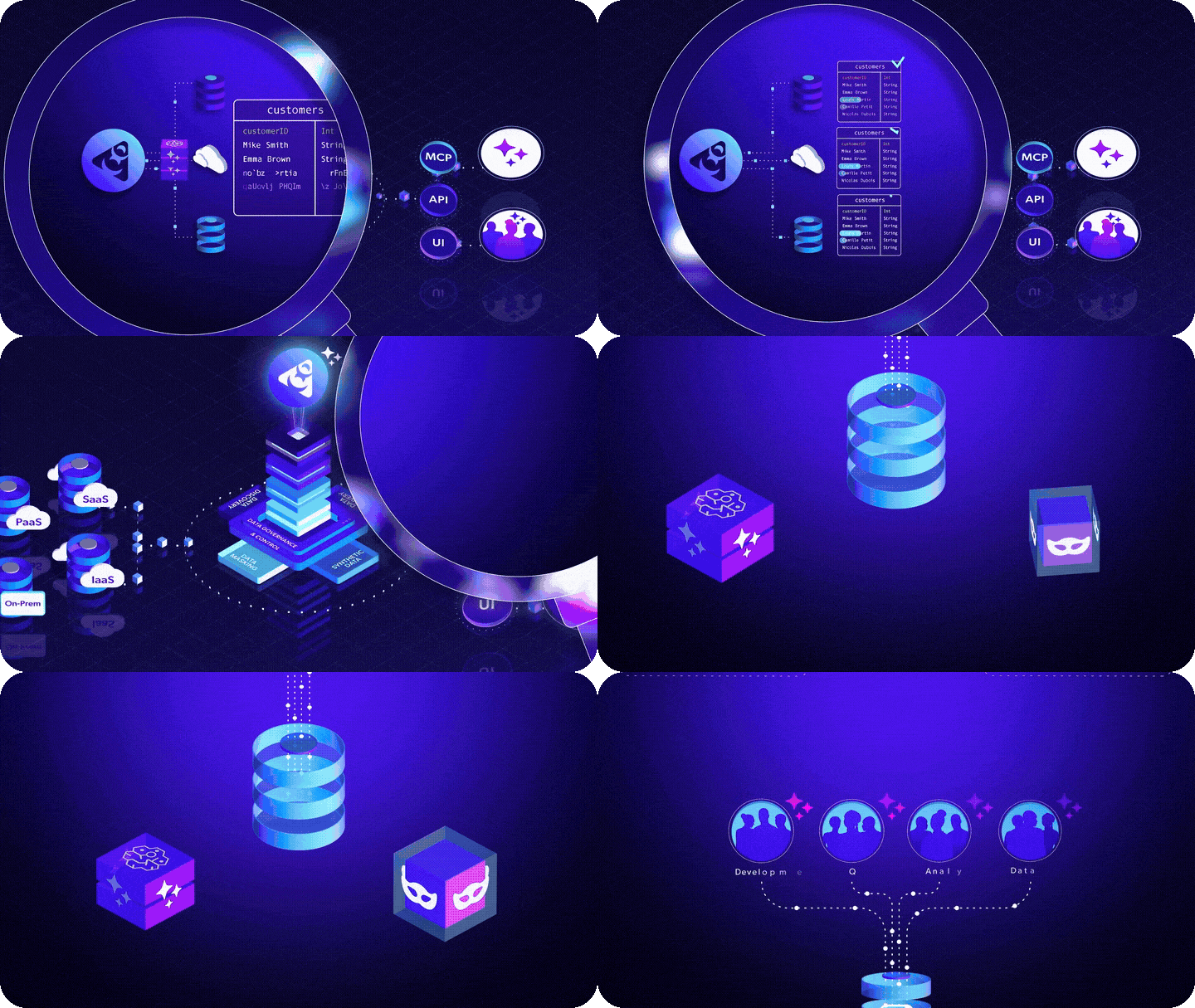
Delphix maintains the referential integrity of synthetic and masked data across connected systems, not only within an individual database. It builds on the referential integrity Delphix has refined over years of masking data in complex enterprise environments.
- Generation is synchronized across and within heterogeneous databases, such as Postgres and Oracle together.
- Platform-generated keys are handled automatically.
- Data is inserted into databases that already contain data, with awareness of existing keys.
- Schema changes are detected, and generation rules adjust without manual rework.
- Masked and synthetic data share one understanding of relationships, so they combine into one consistent dataset.
Determinism and realism matter in synthetic data because you can only trust data that you can reproduce and that behaves like production. Determinism means the same schema, rules, and seed produce the same dataset every time.
- Without determinism, QA reports failures that engineers can’t reproduce.
- Datasets drift between versions, and you can’t regenerate what an auditor asks about.
- AI agents can’t tell if a failure came from their code or from changing data.
- Without realism, tests go green on data that ignores real business logic, such as an invalid sort code.
Look for a solution that generates data consistently on demand and realism that comes from your own domain. Ask whether it can:
- Use schema, relationships, formats, and business constraints to create realistic data.
- Regenerate an identical dataset from the same schema and configuration, not just a similar one.
- Version that configuration the way you version code.
- Let you inspect and edit business rules, not hide them in a black box.
- Produce realistic data without relying on an LLM call at generation time.
Delphix uses AI to speed up setup, then generates data from governed rules. That keeps output repeatable and realistic.
- AI-assisted discovery and configuration reduce manual setup.
- AI helps configure generation but doesn’t generate the values.
- Business rules are Python-based, so you can inspect and edit them.
- The same rules produce the same output on every run.
- Rules can be versioned and audited like code.
- Realism comes from your schema, cross-table references, formats, and business constraints.

Business rules matter in synthetic data because your software enforces logic that random data ignores. Generated data has to follow the same rules your application does.
- Rules govern valid formats, allowed values, and how fields depend on each other.
- Data that breaks these rules gets rejected, or it tests the wrong things.
- New products, fields, and rules have no production data to copy from.
- Unit and scenario tests need data shaped to specific rules.
Look for a solution that learns your rules automatically and lets you add your own. Ask whether it can:
- Infer rules from your schema and metadata where possible, instead of requiring every rule to be documented and hard-coded.
- Capture rules between columns and between tables, not just within a single field.
- Extend generation for complex, derived values using a standard language, not a proprietary framework.
- Keep working when the schema changes.
Delphix uses AI to configure business rules for you, then lets you extend them with Python where needed. Most fields are handled automatically, and special cases are easy to add.
- AI analyzes your metadata and assigns generation logic to each column.
- That analysis captures rules between columns and tables that manual setup often misses.
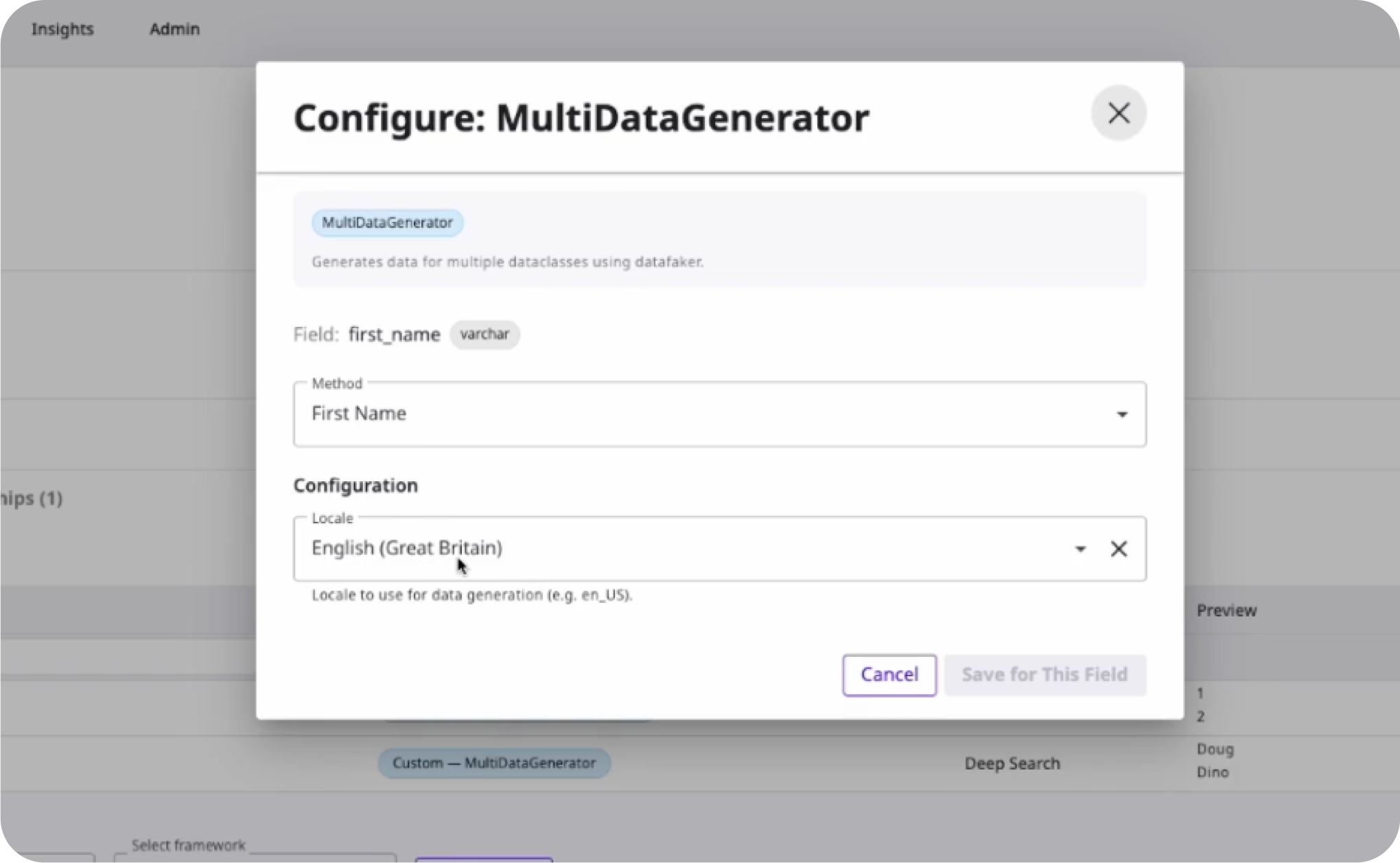
- Custom Python generators handle complex, interdependent values, such as a valid UK driving license number built from a person’s name and date of birth.
- Any developer who knows Python can write rules, with no specialist framework needed.
- When the schema changes, generation rules adjust without manual rework.

Language- and location-specific data matters because global enterprises run on regional formats. Test data has to look like the data your applications handle in each market.
- Names, addresses, currencies, dates, and identifiers vary by region and language.
- Data in the wrong format fails validation or hides defects that appear in one market.
- Teams expanding into new geographies have no production data to copy.
- Schemas in some regions use non-English column names, which slows manual setup.
Look for a solution that generates region-correct data without hand-built rules for every locale. Ask whether it can:
- Generate names, addresses, currencies, and identifiers in the formats each region uses.
- Support the specific locales and languages you operate in.
- Understand schemas with non-English column names without manual mapping.
- Handle region-specific identifier rules, not just generic formats.
Delphix uses locale-aware AI to generate data that fits each region. That cuts manual setup for global applications.
- AI-assisted discovery is locale-aware.
- It identifies business meaning in non-English column names without manual input.
- It assigns generation logic to each column automatically.
- Custom Python rules can cover region-specific identifier logic.
- Teams can generate data for a new geography before any production data exists there.
Data shape and distribution matter because applications behave differently on realistic data than on evenly random data. Shape is how values cluster, skew, and repeat across your records.
- Real data has proportions, such as the mix of states, event frequencies, and transaction types.
- Evenly spread random data can hide query and performance problems.
- It can also leave out the rare events your application must handle.
- Tests on unrealistic shapes can pass while real-world behavior goes untested.
Look for a solution that builds realistic proportions into generation from the start. Ask whether it can:
- Produce realistic proportions, frequencies, and skew, not just valid values.
- Base the shape of generated data on statistical analysis of your data, not uniform randomness.
- Learn the shape of your data without exposing actual data or PII to an AI or LLM.
- Let you adjust distributions for a specific scenario, such as more failed transactions.
- Show you a preview so you can check the shape before generating at scale.
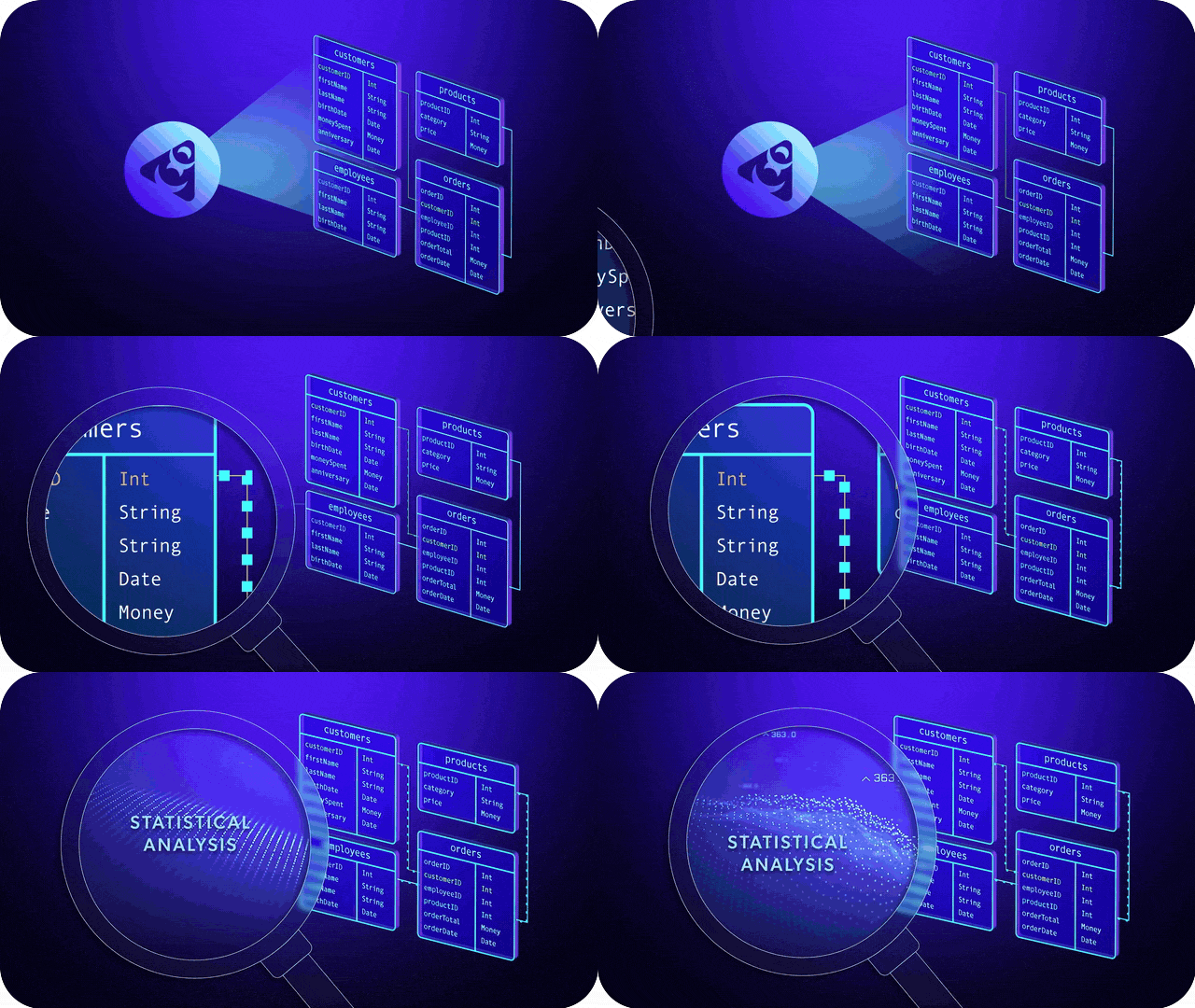
Delphix uses statistical analysis to learn the shape of your data. It then configures generation to match, so the result has a representative shape and distribution.
- AI scans only metadata and schemas to discover data structures and relationships.
- Statistical analysis captures the shape and distribution of your data.(No actual data or PII is exposed to AI or LLMs in this process.)
- Generation logic is configured automatically from that analysis.
- Generated values follow realistic proportions and frequencies, not uniform randomness.
- You can fine-tune the data with natural-language requests.
- A sample preview lets you check the shape before generating the full dataset.
Ease of use matters in synthetic data because the people who need data are often not data engineers. If only specialists can generate data, everyone else waits in a queue.
- Testers and developers need data for new features without writing scripts.
- Every new rule or schema change becomes an engineering ticket.
- Business users need realistic data for training and user acceptance testing.
- AI agents need to request data themselves, without a person in the loop.
Look for a solution that lets non-specialists get usable data without deep database knowledge. Ask whether it can:
- Discover your schema and configure generation automatically, instead of requiring regex and manual rules.
- Accept plain-language requests from testers and developers.
- Show a preview of the data before you generate it at scale.
- Offer APIs so pipelines and agents can request data on their own.
Delphix offers an easy-to-use interface with an AI assistant. Teams describe what they need and get realistic data in minutes.
- AI discovers your schema and configures generation automatically.
- The in-product AI assistant turns a plain-language request into the relevant data. Example: “Create 200 customer records, each with multiple valid orders.”
- A sample preview lets you fine-tune the data before the full run.
- Open APIs and MCP access let pipelines and AI agents request data without manual jobs.
- Developers, testers, and agents can generate and deliver data on-demand, without waiting for a specialist.

Correlations and patterns matter because realistic scenarios depend on fields that move together. Data with unrelated fields can pass validation but still not look like real behavior.
- A customer’s location, product, and price should fit together.
- A name and date of birth should match the identifier built from them.
- Production data often lacks the invalid, out-of-bounds, and rare-but-valid cases that edge-case and negative testing need.
- Without credible patterns, tests miss how your application behaves in the real world.
Look for a solution that preserves relationships between data elements and lets you create edge cases on purpose. Ask whether it can:
- Keep related fields consistent within a record.
- Keep patterns consistent across records and tables.
- Generate rare, invalid, or out-of-bounds data on demand.
- Tailor data to a specific test scenario, not just a generic dataset.
Delphix uses AI to understand your data, then configures generation to preserve how it fits together. Teams can then shape the data for each scenario.
- AI-assisted discovery infers what data means, how it relates, and its industry context.
- Generation is configured automatically to preserve those relationships and patterns.
- Teams generate data on-demand for a specific testing scenario. (Important note: Unlike other tools, Delphix does not use an LLM to generate data, which would result in non-deterministic data and excessive hidden costs.)
- Edge cases and negative scenarios can be created deliberately, not left to chance.
- Natural-language requests and a sample preview help fine-tune the result.

A unified platform matters because enterprise testing needs more than synthetic data. Teams also need masked data, fast delivery, and a single control plane.
- Masked data covers established workflows. Synthetic data covers new features, edge cases, and negative tests.
- Separate tools leave teams to reconcile keys and relationships by hand.
- Generated data only helps if it reaches every dev, test, and agent environment quickly.
- Policies and visibility fragment across separate tools.
Look for a solution that treats synthetic data as part of a complete test data strategy. Ask whether it can:
- Combine masked and synthetic data into one dataset with relationships intact.
- Deliver data quickly to many environments, not just generate it.
- Support blended or synthetic-only data, depending on the test.
- Give you one central place to see your data environments and apply consistent policies.
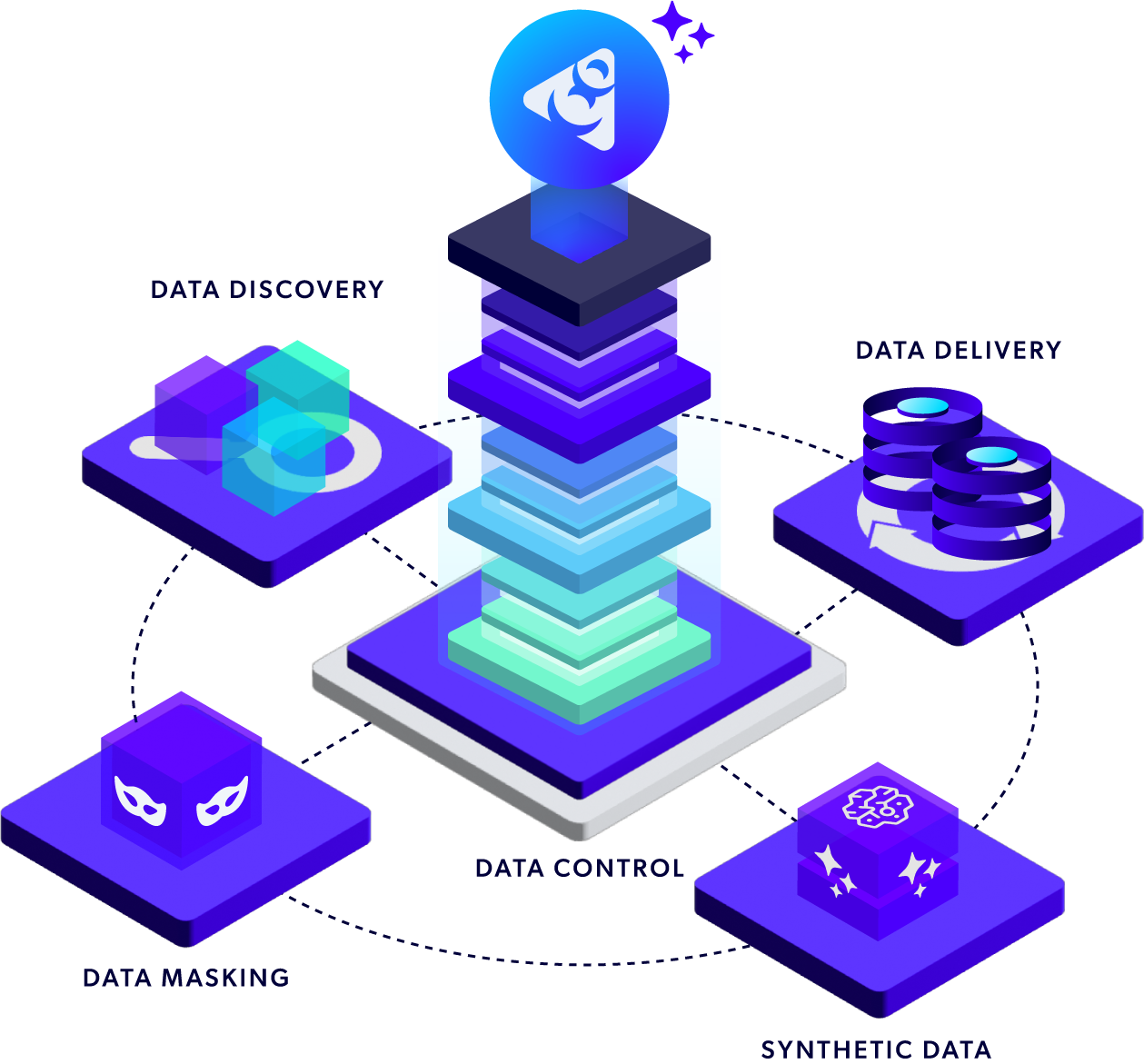
Delphix Synthetic Data is part of the Delphix DevOps Data Platform. The platform also includes sensitive data discovery, data masking, data virtualization and delivery, and centralized data control.
- Sensitive data discovery: Automatically identify sensitive data across enterprise environments to improve visibility, compliance, and protection.
- Masking: Masked and synthetic data share one understanding of relationships, so they behave like one system.
- Virtualization and delivery: Space-efficient virtual copies and automated delivery get data into dev, test, and agent environments fast.
- Centralized control: One place to see your data environments and apply consistent policies across masked and synthetic data.
Self-service data environments matter because generating data is only part of the lifecycle. Teams also need to deliver, refresh, share, and reproduce it.
- Large teams and AI agents multiply the number of environments needed.
- Waiting on tickets for each refresh slows development.
- Debugging means getting back to the exact data state where a bug appeared.
- Shared datasets drift unless they are versioned and controlled.
Look for a solution that manages data across the development lifecycle, not just at generation. Ask whether it can:
- Rewind, bookmark, branch, and reset datasets — not just generate static copies.
- Give each developer or agent an isolated environment.
- Provision environments quickly without excessive storage.
- Offer APIs so teams and agents can self-serve without tickets.
Delphix lets teams and agents get, reset, and reproduce data on their own. Synthetic data can be delivered instantly to individual sandboxes.
- Generated data is delivered to one-to-one sandboxes for large teams and agents.
- Self-service APIs support refresh, rewind, bookmark, branch, and reset.
- Space-efficient virtual copies keep many environments affordable.
- Rewind and bookmarks return teams to the exact data state where a bug appeared.
- The MCP server lets agents run data operations and see which environments and snapshots are available.
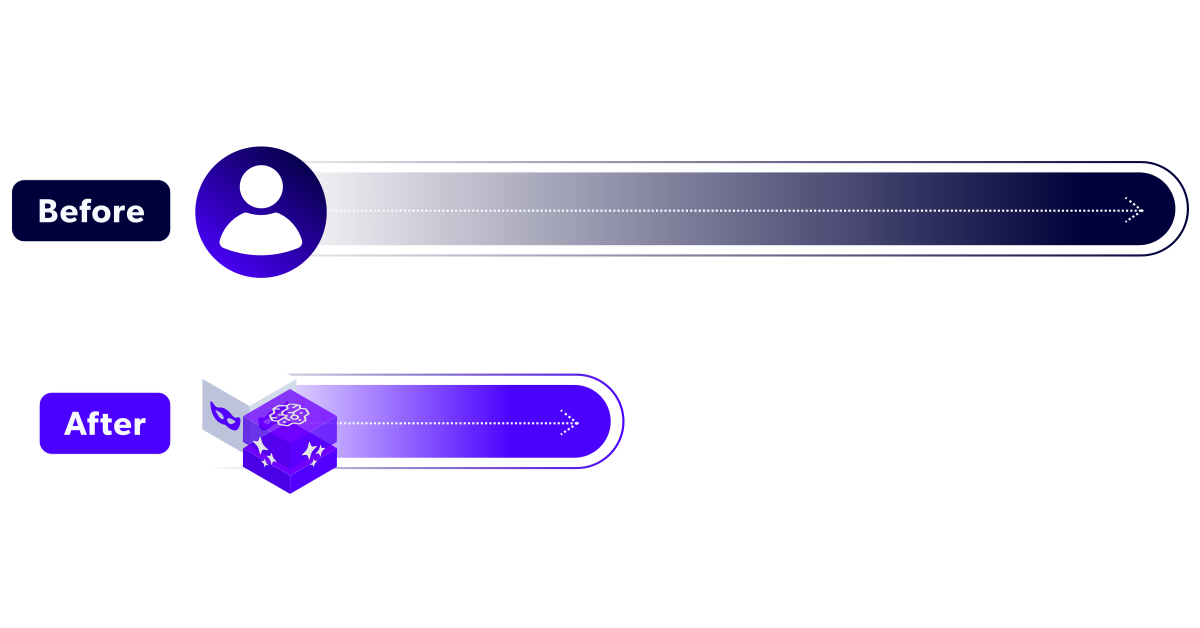
Governance matters because synthetic data still has to follow enterprise rules. Self-service and AI agents make clear controls more important, not less.
- Auditors ask what data a test used and who generated it.
- Separate tools mean separate policies and fragmented audit trails.
- Self-service and agent requests need guardrails.
- Synthetic-only mandates need to be enforced consistently.
Look for a solution that governs masked and synthetic data in one place. Ask whether it can:
- Apply central policy across both masked and synthetic data.
- Keep audit trails of what was generated, by whom, and with which configuration.
- Control access and set guardrails on self-service and agent requests.
- Regenerate a past dataset on demand for an audit.
Delphix applies one governance framework to masked and synthetic data. Security and compliance teams get a single place for policy and audit.
- Policy-based governance spans masked and synthetic data.
- Audit trails record data activity.
- Generation rules are deterministic, so past runs can be regenerated.
- The MCP server gives AI workflows compliance context.
- Controls help keep sensitive data out of non-production environments.

See IDC’s Take on Delphix for Agentic Development
“Vendors such as Perforce Delphix are among the first to address this gap with governed, platform-based, and AI-first approaches to realistic synthetic data generation at agentic speed.”
Get the analyst perspective on why synthetic data is becoming essential to agentic development and how Delphix is addressing the shift.
Read the IDC Spotlight on Delphix Synthetic Data
IDC Spotlight, sponsored by Perforce Software, Why Synthetic Data Is the Next Agentic Development Priority, #US54980926, October 2026
10 Questions to Ask a Synthetic Data Vendor When Evaluating Tools
Image

| |
Can it keep data consistent across all my databases, including tables that already contain data?Can it generate across systems, such as Postgres and Oracle, in one pass? What happens when two databases must share keys? | Image

|
Can it regenerate an identical dataset from the same configuration, without an LLM call at generation time?Are the rules inspectable and versionable like code? Or is generation a black box that gives you similar data each run? | Image
|
Can it learn my business rules automatically and let me extend them in a standard language?Does it infer rules between columns and tables from my schema? Can developers add complex rules in Python, or does that require a proprietary framework? | Image
|
Can it generate region-correct data for every locale I operate in?Does discovery understand non-English column names without manual mapping? Or will you hand-build rules for each locale? | Image
|
Does the generated data have a realistic shape and distribution?Does it analyze my data to set realistic proportions and frequencies? Or does it produce evenly random values? | Image
|
Can a tester or developer get usable data without data engineering skills?Can they ask for what they need in plain language, preview it, and get data in minutes? Can pipelines and AI agents request data through APIs or MCP? | Image
|
Can it create correlated, edge-case, and negative-test data on-demand?Does it keep related fields consistent and tailor data to a specific scenario? Or are you limited to generic datasets that cover only the happy path? | Image
|
Is synthetic data part of a platform with masking, delivery, and central control?Can masked and synthetic data combine into one dataset and reach every environment quickly? Or will you piece together multiple tools? | Image
|
Can teams and AI agents self-serve data environments and rewind them when something breaks?Can they refresh, rewind, bookmark, branch, and reset data in their own sandbox? Or does each refresh require a ticket? | Image
|
Can it govern synthetic data with the same policies and audit trails as masked data?Can you regenerate a past dataset for an audit? Does it set guardrails on self-service and agent requests? | Image
|
Put This Checklist to the Test
See how Delphix Synthetic Data measures up against every question on this list. Request a custom demo, and one of our product experts will walk you through it.
Why Implement Enterprise-Ready Synthetic Data Now?
Now is the time to implement an AI-ready synthetic data solution that is fit for complex enterprise development because the next advantage in software delivery belongs to teams that can validate code as fast as AI can write it. Code is no longer the slow part. Trusted, realistic test data is, and the right synthetic data solution is what puts it in reach.
Three reasons to act now:
1.
Agents can’t wait. They write and run tests faster than people do, and idle agents are costly. To keep them busy, teams often fall back on stale or low-quality data, or even unsecured production data.
2.
Bad data hides bad code. Without referential integrity, agents can keep testing on broken records and even mark failed tests as successful.
3.
Early movers pull ahead. Teams that put scalable synthetic data in place now will be better placed to innovate quickly without sacrificing quality or compliance.
FAQ: What Else Do Buyers Ask About Delphix Synthetic Data?
Scripts can work for one application, but they’re hard to scale and maintain. Relationships across systems are difficult to script, and every schema change can become an engineering ticket. Delphix configures generation from your schema.
A general-purpose LLM can help with a quick, one-time prototype. It’s harder to rely on at enterprise scale.
- You have to build schema awareness, relationships, and rules yourself.
- Output isn’t guaranteed to be identical from run to run.
- Cost can add up for large volumes.
Delphix uses AI to configure generation, then generates from governed rules, so results are repeatable.
Delphix doesn’t send your production data to an LLM, and you don’t need one. The built-in AI runs locally in your environment. It’s used to understand how to generate data, not to generate it. If you prefer, you can bring your own governed LLM.
Delphix Synthetic Data uses AI to scan metadata and schemas to discover data structures and relationships. No actual data or PII is exposed to AI/LLMs in this process.
Delphix uses statistical analysis to analyze the data and understand its statistical properties so Delphix can reflect statistical shape and distributions in synthetic data.
It also provides an AI-first interface with prompt-based generation. It makes it easy to create realistic data tailored to specific scenarios.
Delphix Synthetic Data works with JDBC-compliant databases, including Oracle, SQL Server, PostgreSQL, and Snowflake. It can generate across several of them at once. SaaS applications that don’t allow database access through JDBC aren’t supported yet.
Once connected, teams can generate data in minutes. To start, you need:
- A connection to your source database schema.
- A target database to load data into.
- One or two scenarios to start with.
No. Delphix Synthetic Data can be used on its own, but it is also designed to work within the Delphix DevOps Data Platform. When used together with data masking and data delivery, it provides a more comprehensive solution for generating, delivering, and governing test data.
What Could Your Teams Do with Safe, Realistic Synthetic Data On-Demand?
Delphix Synthetic Data lets developers, testers, and AI agents generate the data they need without waiting or exposing production data. Request a custom demo, and a Delphix product expert will show you how.