
Blog
October 13, 2026
Perforce IPLM vs IC Manage for Semiconductor Workflows

Embedded Systems & Chip Design,
Data Management
IC Manage Global Design Platform (GDP-AI) and Perforce IP Lifecycle Management (IPLM) are both used in the semiconductor industry to manage circuit and chip design assets, but each approaches the challenge from a different perspective:
IC Manage GDP-AI is a data-management-first platform. It manages design libraries, workspaces, IP instances and revision history through a common database. IC Manage GDP is based on Perforce P4, which is why it shares many of the same scalability, fine-grained permissions, and atomic change tracking benefits as the P4 platform.
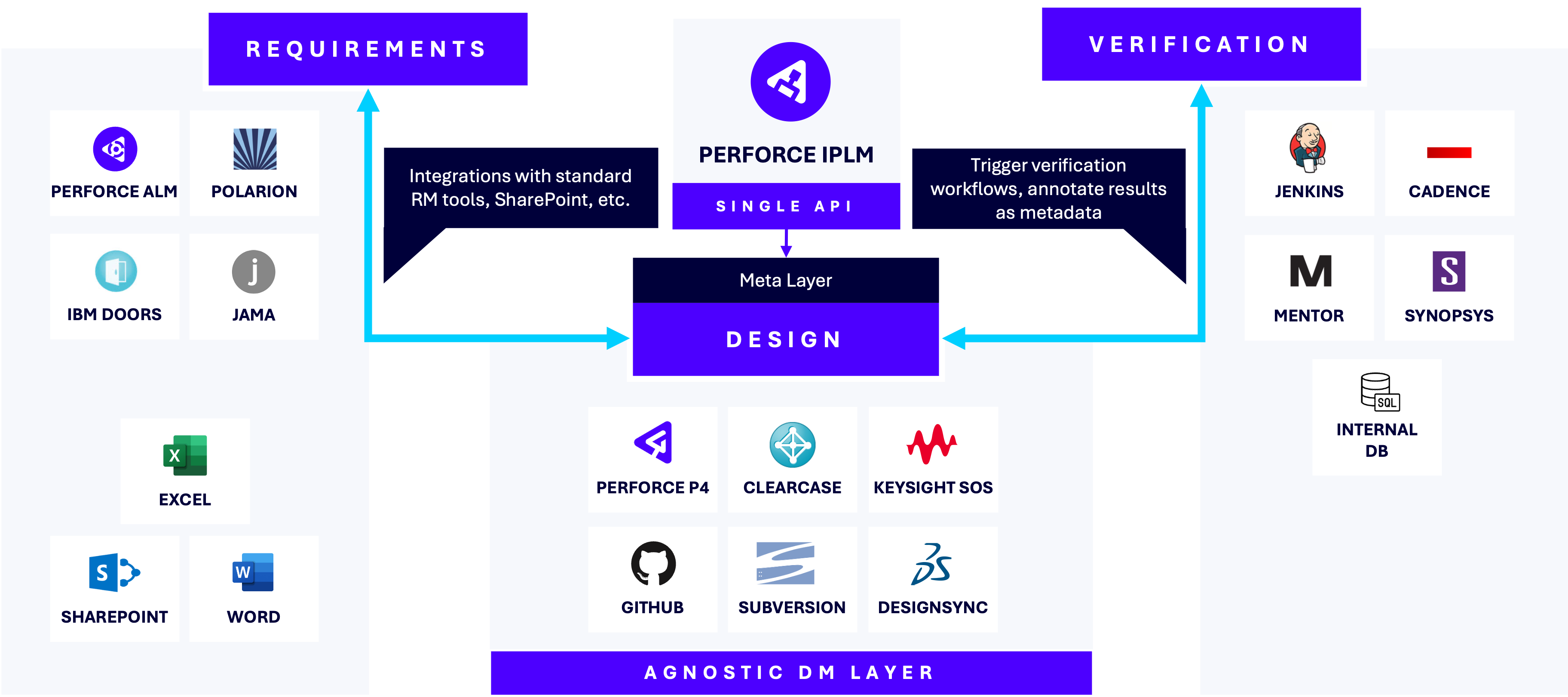
Perforce IPLM is a technology-agnostic application that adds IP management capabilities. It helps teams establish a unified design environment, regardless of the data management or version control systems they work across. IPLM assembles data across requirements, verification, and design tools into a unified IP catalog that teams can use to find and track IP for reuse. As a Perforce solution, IPLM offers a deep level of integration with Perforce P4. For instance, IPLM permissions can be propagated to P4, giving a single point of control for IP access management.
In this guide, we provide side-by-side views of the features in Perforce IPLM vs IC Manage and analyze their strengths and weaknesses for a variety of scenarios. The goal is to provide a comprehensive comparison that helps you choose the best IP management platform for your needs.
Back to topA High-Level Comparison: Perforce IPLM vs IC Manage GDP-AI
Before we zoom in on specific features and capabilities, here are fundamental ways in which Perforce IPLM and IC Manage GDP-AI differ:
| Capability | Perforce IPLM | IC Manage GDP-AI |
|---|---|---|
| Primary role | Adds IP reuse framework to most data management or version control systems | Combined design and data management |
| Product Mindset | IP-centric: Treats every element (design blocks, environments, configurations, PDKs, software) as a first-class reusable IP object. | Project-centric: IP instances, versions, and permissions are organized by project, which can create boundaries for IP reuse across projects. |
| Data Management and Version Control Compatibility | Different systems can exist in a single IP hierarchy. Works with Perforce P4, Subversion, and git-based tools like GitHub. Has a DM handler mechanism to support any other data management system required (Keysight SOS, Dassault ENOVIA (DesignSync), ClearCase and more). | Works with git-based tools like GitHub. Subversion and other DMs need to be imported or adapted through IP Central. |
| Permissions and access |
Fine-grained permissions at the library, IP, and line level, with optional geofencing to restrict access by geographic location. IPLM permissions can be propagated into the underlying data management system, including Perforce P4, for a single point of control over access. | Fine-grained permissions with project, file, or IP address filters. |
| EDA tool integration | Provides EDA agnostic IP layer. Perforce has extensive integrations with Siemens, Cadence, Synopsys, and Keysight. | Deeply integrated design-data layer. Cadence Virtuoso is signature integration with AMD Vivado and Altera Quartus for FPGA development |
| AI capabilities | Natural language queries and document search can be conducted within the application, through native MCP and RAG server integration. | Natural language queries, workflow scripts, and documentation search can be conducted within the application. |
Key Takeaways:
- IC Manage GDP-AI offers a strong set of features for companies looking to combine their data management and IP management workflows into a single application.
- Perforce IPLM offers that same set of features for teams that store their IP in a variety of data management and version control systems across their hardware, firmware, requirements, and verification workflows.
What Is Perforce IPLM?
Perforce IPLM is an IP lifecycle management system that helps teams establish a unified IP reuse framework across their teams and 3rd party vendors. IPLM assembles metadata across requirements, verification, and data management tools into a unified IP catalog that helps teams find, track and reuse IP Cores and their components.
This technology-agnostic model helps organizations establish wider context and deeper traceability across their entire design lifecycles.
What Is IC Manage GDP-AI?
IC Manage GDP-AI is a design data management platform that helps engineering organizations manage design libraries, workspaces, configurations, and engineering data across chip development projects.
It helps engineers efficiently access, version, and collaborate on IP and circuit design assets in one application.
Back to topHow AI Capabilities Differ Between Perforce IPLM and IC Manage GDP-AI
Perforce IPLM and IC Manage GDP-AI boast nearly identical AI architectures and features. Both use the Model Context Protocol (MCP) to give an AI real-time, structured access to live system data. Both use retrieval-augmented generation (RAG) grounded in their own documentation. Both offer a natural-language assistant, so engineers can query and manage IP conversationally instead of memorizing command syntax.
The difference lies in what the two platforms can query and surface to the end user:
- Perforce IPLM’s AI Assistant reasons over a unified metadata layer, a Neo4j graph database that spans all of your tools. This makes your AI tools more effective as IP objects, versions, specs, status, dependencies and requirements can be queried through a central database, even across a mix of data management systems.
- IC Manage GDP-AI's Assistant reasons over data and designs stored in its GDP design database. This limits the AI Assistant’s visibility to what is stored in IC Manage, and requires teams to build and maintain separate connections to data and IP stored in other tools or systems.
Align Your IP Management Software to the Way You Work
Choosing the right software isn’t just about comparing features. It’s about finding the solution that best fits with your goals, existing tech stack, and team dynamics. In the following section, we break down some common scenarios, and the pros and cons of Perforce IPLM and IC Manage GDP-AI in each.
You Want to Establish a Unified IP Reuse Program, But Are Already Running a Different Data Management Solution
If you’re already using a commercial design data management system like Keysight SOS or Dassault DesignSync, adopting IC Manage GDP-AI would also push your teams to change their version control infrastructure. Perforce IPLM takes the opposite approach, providing a technology-agnostic IP-reuse framework on top of the systems you already run. This allows engineering leads to solve for higher-level IP reuse needs without requiring team to also replace their design data management.
Best Option: Perforce IPLM
Your Company Develops Digital, RTL, and Large SoC Designs
Perforce IPLM excels here due to its IP-centric abstraction. It manages RTL blocks as "IP objects" with defined interfaces and quality states, independent of the file storage. This is powerful for SoC integration, where the focus is on assembling pre-verified blocks (internal and 3rd party) rather than editing individual RTL files. It enforces strict compatibility rules (e.g., ensuring a specific RTL version matches its UVM testbench) before integration.
For large distributed teams, working in parallel with vendors and technology partners, Perforce P4 can be integrated with IPLM? to provide a scalable and secure version control foundation. The permissions management in both Perforce P4 and IPLM are highly configurable and fine-grained access controls can be setup to be granted once and then propagate everywhere, as well as take on permissive or restrictive defaults based on the IP type.
Best Option: Perforce IPLM
You Co-Develop Hardware and Firmware
Perforce IPLM is highly favored in automotive and safety-critical sectors (ISO 26262) for its rigorous audit trails. IPLM can create system-level BOMs and compatibility matrices (e.g., "Driver v2.0 is only compatible with Hardware IP v1.5+"). If a hardware engineer promotes a new IP version that breaks the API, IPLM automatically flags the incompatibility for the software team.
Best Option: Perforce IPLM
You’re an Independent Semiconductor Provider
If you are developing designs yourself, or as part of a self-contained team, you likely won’t run into the reuse and governance challenges IPLM is built to solve. There’s no other department’s IP catalog to reconcile, no vendor or contractor working in a different data management system, and no acquisition bringing in its own toolchain.
In this scenario, IC Manage GDP-AI’s combined, single-database approach is the better fit. You’ll get fast, native access to your design blocks and configurations without the overhead of standing up a separate reuse framework on top. IC Manage GDP-AI’s project-based approach should also align well with how your team operates.
Best Option: IC Manage GDP-AI
Additional Considerations:
- If You're Heterogeneous, Multi-site, or Integrating an Acquisition: Perforce IPLM is the stronger fit when you need a framework that makes IP reusable without forcing everyone onto one system. Its breadth (everything is an IP object, including hardware, software, and system BOM), governance, and team-by-team adoption path are built for heterogeneous, evolving organizations.
Best Option: Perforce IPLM - Your Core Teams Are Already Standardized on GDP-AI: If the majority of your design files and projects are already stored in IC Manage GDP-AI, aligning smaller cohorts towards a version control and IP management solution which already has wide internal adoption should require less change management.
Best Option: IC Manage GDP-AI - If You’re Driven by Traceability and Breadth: You need everything modeled and traceable, with strict governance for regulated work. Perforce IPLM models every design element as IP in a single hierarchy and adds strong security measures like geofencing, region-based access, audit logs, and license controls to deliver compliance-ready products.
Best Option: Perforce IPLM
 How to Choose the Best IP Lifecycle Management Platform for Your Team
Choosing the right platform comes down to determining what you're trying to manage and how you can best manage it.
One practical advantage of Perforce is that it doesn't force you to solve everything at once, and provides two flexible entry points:
- If your first priority is to incorporate a more scalable version control solution than GitHub or Git-based tools, Perforce P4 is a cost-effective and technology-agnostic path to start, with many on-prem, hybrid, or cloud deployment options available.
- If your first priority is to establish a unified IP reuse program, Perforce IPLM is a technology-agnostic framework that won’t lock you in to a specific data management solution.
To get a personalized, no-obligation demo of Perforce IPLM, simply click below. One of our product experts will tailor the experience to your needs and answer any questions you have. We look forward to meeting you!