
Blog
May 7, 2026
Static Data Masking vs. Dynamic Data Masking: What’s the Best Approach?


Data Management,
Security & Compliance
Data masking comes in different forms: dynamic vs. static masking. Each has its own characteristics, use cases, and methods for data protection. But when it comes to comprehensive, consistent protection, static data masking rises above.
In this blog, we’ll break down where dynamic data masking works, how it fails, and which use cases you need to use static masking for.
What is Static Data Masking?
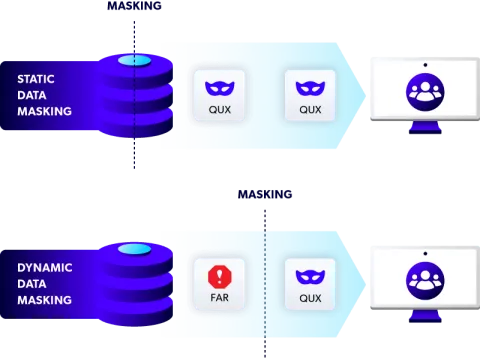
Static data masking is the process of replacing sensitive values with fictitious, yet realistic equivalents. With static data masking, data is changed at rest and written to the data source. This kind of data masking — unlike dynamic data masking — is irreversible.
For example, static masking could change an SSN from 123-45-1890 to 045-12-3345.
Use Static Data Masking for Non-Production Data
Static masking is ideal to protect sensitive data and provide production-fidelity data in test and analytic environments. It is not used on production data.
Find out why static data masking is the best approach in our on-demand webinar: Five Approaches for Protecting DevOps Test Data.
What is Dynamic Data Masking?
Dynamic data masking is the process of replacing sensitive data during the data retrieval process, rather than at the source. With dynamic masking, data is changed during delivery or presentation of the data. The original source data is not changed.
For example, a customer service rep might see XXX-XX-0341 on their screen, but back in the database, the full SSN is still intact.
Use Dynamic Data Masking for Production Data
Dynamic data masking is ideal for production break-fix or other use cases where production data is required. It is not used to produce test or analytic data sets.
Explore More: Get the complete guide to data masking methods and techniques >>
Back to topStatic Data Masking vs. Dynamic Data Masking
The main difference between static data masking and dynamic data masking is this: Static masks the database itself while dynamic masking keeps original data and shows users redacted data as part of read query result.
How Data is Masked: Static Masking vs. Dynamic Masking
In static data masking, the original data is replaced by masked data before the data is copied to a less secure non-production (non-live) database. Masked data in this context is data that cannot be re-transformed back to its unmasked value.
There is no path back to the original value. For example, the name “David” becomes “Bob.” If a fraudster gets a hold of this masked data, they won’t be able to reverse the new value or get the original data.
In dynamic data masking, the original data remains unchanged in the production database, but the data served to the user is redacted. For example, the name “David” becomes “XXXXX”. A fraudster would be able to trace the anonymized data back to the original value — a path that makes the data still vulnerable.
REPORT
How Popular is Dynamic Data Masking?
60% of organizations we surveyed for the 2026 State of Data Compliance and Security Report use dynamic data masking, while 86% use static data masking. Discover additional masking and compliance insights around sensitive data, compliance, masking, and AI from 500+ global leaders.
Who Should Use Static vs. Dynamic Data Masking?
Out of the 500+ global enterprise leaders surveyed in our 2026 State of Data Compliance and Security Report, 95% use static data masking and 76% use dynamic data masking. Often, according to our report, large enterprises will combine approaches to data masking and leverage whichever best fits their needs.
While there's some overlap between the use cases for static vs. dynamic masking, here are some examples for each approach:
Static Data Masking Use Cases
Organizations typically use static data masking in scenarios where they want to irreversibly protect sensitive data and mitigate risk. This could include:
- Software development and testing.
- Third-party vendor access.
- Business continuity testing.
- Training and education.
- Analytics.
- Scenarios where the overhead associated with dynamic is not acceptable.
Dynamic Data Masking Use Cases
Dynamic masking is sometimes used for:
Read-only applications.
Certain analytics environments (though using static masking is still preferred in most circumstances).
Production systems (such as medical records systems).
Operational reports.
Best Data Protection: Static vs. Dynamic Data Masking
If a database is breached, only static data masking will protect sensitive data from compromise. That’s because the sensitive data in the database itself has been replaced with irreversible fictitious values.
If the database was protected with dynamic data masking, the breach will result in the compromise of any sensitive data. The database still contains sensitive data.
Especially when there is sensitive data sprawl, it’s critical to eliminate the risks. Typically, non-production environments do not have the extensive auditing and security controls that are present in production environments.
In addition, many more users have access to non-production systems. For these reasons, it is imperative to protect non-production environments by eliminating the sensitive data they contain.
This data privacy risk isn't hypothetical: 43% of organizations report having experienced audit failures, and 34% report breaches or theft of sensitive data in non-production environments, according to the 2026 State of Data Compliance and Security Report. Static masking closes this gap by eliminating recoverable sensitive data from non-production systems altogether.
Data Masking for AI: Static or Dynamic Masking?
When it comes to artificial intelligence (AI), organizations subject to privacy regulations must proceed with caution. For example, the General Data Protection Regulation (GDPR) requires transparency and data subject rights for consumers that complicate using data for AI training.
Masking can support such data privacy requirements under various regulations and make data AI-ready. Since data can be reidentified after dynamic masking, it’s not the best fit for AI workflows. Static data masking, however, ensures AI cannot trace back to the original source data or pose risk to consumer data privacy.
Static data masking is also better aligned with AI training, inference, and analytics workloads because it eliminates the runtime overhead associated with dynamic masking during query execution and data retrieval.
AI workloads often involve processing massive volumes of data, and applying masking policies dynamically can:
Introduce latency
Increase compute overhead
Impact performance at scale
By masking data once and creating a permanently protected dataset, static masking enables AI operations to be:
Faster
More efficient
Scalable
Stronger in regards to privacy protection
Advantages of Static Data Masking Over Dynamic Data Masking
There are five key advantages of static data masking over dynamic data masking.
Zero Trust & Data Security
One component of zero trust is complying with privacy laws by masking PII and PHI. Static data masking delivers on zero trust by masking that data before it goes in a non-production environment.
Dynamic data masking is less secure in non-production environments. The real-time nature of dynamic data can be a vulnerability.
Referential Integrity
Application development and testing teams need production-like copies of the production database for their testing. Sensitive data in those databases needs to be masked while preserving referential integrity. If it doesn’t maintain its integrity but developer still use it, the data cause issues such as:
Poor application quality
Static data masking is the best way to ensure referential integrity across tables, schemas, databases, and cloud environments.
No Agents
Dynamic data masking often requires an agent, different JDBC driver, or a proxy service between the data and the data requester. As a result, it can be very challenging to implement dynamic data masking across all types of data sources present in an enterprise.
With static data masking, no agents or proxy services are required.
No Overhead Caused by Agents
Dynamic data masking has overhead associated with it. Every time a query is executed, the access rights of the user need to be established. The users mustmask specific elements of the data.
With static data masking, the changes to the data have already been persisted. There is no overhead or change to the way teams get their data delivered.
Works on Mainframe and File Data
Static data masking can be applied to data sources that include mainframe and file data. Mainframe and file data is difficult and, in some cases, impossible to present via a dynamic data masking layer. This is due to security reasons as well as logistical reasons.
Back to topHow Static Data Masking Works with Perforce Delphix
Perforce Delphix static data masking is a powerful way to protect sensitive data in non-production environments.
With Delphix, you can automatically discover sensitive data AND mask it to provide production-like data. This is done using a rich library of pre-built and customizable algorithms. As a result, you’ll be able to mask everything from names and social security numbers to images and text fields.
Want to see how sensitive data discovery works? Watch this quick demo from my colleague Felipe Casali and see for yourself how easy it is to discover sensitive data with Delphix.
Delphix static data masking can be applied to various sources. This includes databases — such as SQL Server and Oracle — and analytical sources — such as Snowflake and Databricks.
By leveraging Delphix static data masking, you’ll ensure data security, utility, and referential integrity across data sources. An IDC white paper found that Delphix helped organizations mask and protect 77.2% more data and data environments.*
Delphix Static Data Masking in Practice
Here are some examples of Delphix static data masking in practice to achieve speed, quality, and compliance:
- Worldpay from FIS relies on Delphix to automatically mask sensitive data. As a financial services organization, they have tons of sensitive data that customers trust will be held securely. By utilizing Delphix, they were able to mask data and automate test data management. As a result, they achieved 7x faster refreshes for test environments and reduced test data storage by 75–80%.
- Another financial services organization — Boeing Employees Credit Union (BECU) — saw similar results. By masking sensitive data with Delphix, they ensured consistency and reliability. They also achieved speed — in just 15 hours, they masked 680 million rows of data.
- In the insurance industry, Delta Dental uses Delphix to mask data and deliver virtual data copies to a team of 200 developers in minutes. And they can trust that PII and PHI are masked before the data is replicated.
- For Proximus, a telecommunications company, leveraging Delphix led to a 97% reduction in data masking time, as well as 85% reduction in non-production data storage. Plus, Delphix reduced wait times for testing teams, enabling them to move faster.
Get Demo
Mitigate Risk with Perforce Delphix Static Data Masking
Delphix offers powerful static data masking and compliance solutions that seamlessly replace sensitive data with fictitious but realistic equivalents. This transformation ensures that sensitive information is protected while maintaining the integrity of your data systems.
Related Blog >> What is Delphix?
Achieve Compliance & Guard Against Breaches
With Delphix, you can centrally define and implement masking policies across your enterprise, aligning with key privacy regulations like GDPR, CCPA, HIPAA, and PCI DSS. By masking sensitive data, Delphix minimizes the risk of breaches in non-production environments, which often contain vast amounts of data vulnerable to cyber threats.
Integrate Static Data Masking with Virtualization
The Delphix DevOps Data Platform combines static data masking with virtualization to provide secure, compliant data for development, testing, analytics, and AI. Masked, virtual data copies mimic full physical copies but require minimal storage and can be delivered in minutes, ensuring quick and safe data access across your operations.
Start Your Data Masking Journey with Delphix
Experience how Delphix's static data masking facilitates fast, automated compliance and protects your sensitive information. Request a risk-free demo today and discover why industry leaders rely on Delphix to reduce data risks and enhance privacy.
SHARABLE PDF: Read More About Delphix & Its Benefits
*IDC Business Value White Paper, sponsored by Delphix, by Perforce, The Business Value of Delphix, #US52560824, December 2024