
Blog
December 3, 2025
How to Write a PRD: Your Complete Guide to Product Requirements Documents

Application Lifecycle Management
A Product Requirements Document (PRD) articulates the purpose, features, and functionality of a product. It is a blueprint for development teams to understand:
- What they're building
- Who it's for
- What purpose it will serve
While the exhaustive PRDs of the past are less common in today's Agile landscape, their core function remains the same: to align all stakeholders so that everyone from product managers to developers and testers shares a common vision.
For businesses in highly regulated industries or those creating complex systems, a comprehensive PRD is essential to guide development and meet compliance. For teams using Agile or hybrid frameworks, a concise PRD ensures everyone launches around a unified vision.
This guide provides a comprehensive overview of creating an effective PRD, including the key components, a step-by-step process outline, and strategies for achieving traceability. We also show, with examples, how a requirements management tool simplifies the process and makes it easy for teams to track requirements from a single source of truth.
Watch Now: PRD Creation Simplified
Back to topWhat Is a Product Requirements Document (PRD)?
A PRD outlines a product's requirements from the user's perspective. It focuses on what the product should do, not how the team will build it.
Typically, a PRD is created by the product manager in collaboration with key stakeholders. It translates business objectives and user needs into a single source of truth for the development team so that everyone—including developers, designers, testers, project managers, and other stakeholders—understands the scope and purpose of the product before development begins.
Why PRDs are Still Important in Agile Development
While extensive documentation may seem counter to the Agile framework, managing requirements is still critical.
Instead of a static report, an Agile requirements document becomes a dynamic, living artifact that includes purpose, features, and timeline but conveys the information through:
- User Stories: Capturing functionality from the user's point of view.
- Epics: Grouping related user stories into larger bodies of work.
- Acceptance Criteria: Defining the conditions a feature must meet to be considered complete.
Your Agile PRD doesn’t need to be a novel. A lean, well-structured document will prevent scope creep, reduce ambiguity, and guide informed decisions, even as priorities shift.
Back to topAdditional Resource: Agile Requirements and Traceability. Learn how to gather and manage requirements in an Agile setting while maintaining full traceability.
The 10 Core Components of a Modern PRD
A successful product release begins with a PRD that clearly communicates the product's vision through these key elements:
- Introduction & Purpose: State the problem you are solving and for whom. Clearly define the business objectives and how the product aligns with the company's strategic goals.
- Target Audience & User Personas: Detail the specific user segments the product will serve. Outline their needs, pain points, and motivations.
- Features & Functionality: Break down the product's capabilities into specific features. Prioritize these features using Must-have, Should-have, Could-have, Won't-have (MoSCoW) to guide development efforts.
- User Flow & Design: Include wireframes, mockups, or user flow diagrams to provide visual context for how users will interact with the product.
- System & Technical Requirements: Specify non-functional requirements, such as performance benchmarks (e.g., page load times), security standards, scalability needs, and regulatory compliance obligations.
- Assumptions and Constraints: Document any assumptions made during planning, technical or business constraints.
- Risks & Dependencies: Identify potential risks to the project and document any dependencies on other teams or projects.
- Success Metrics & Release Criteria: Define how you will measure the product's success. Outline the key performance indicators (KPIs) and the criteria that must be met for the product to be released. These might include functionality, usability, and performance standards.
- Timeline & Release Plan: Provide a high-level roadmap with key milestones and estimated release dates. This helps manage expectations and coordinates efforts across teams.
- Stakeholder Review & Approval: List all key stakeholders and document their review and sign-off for universal buy-in before development starts.
Back to top
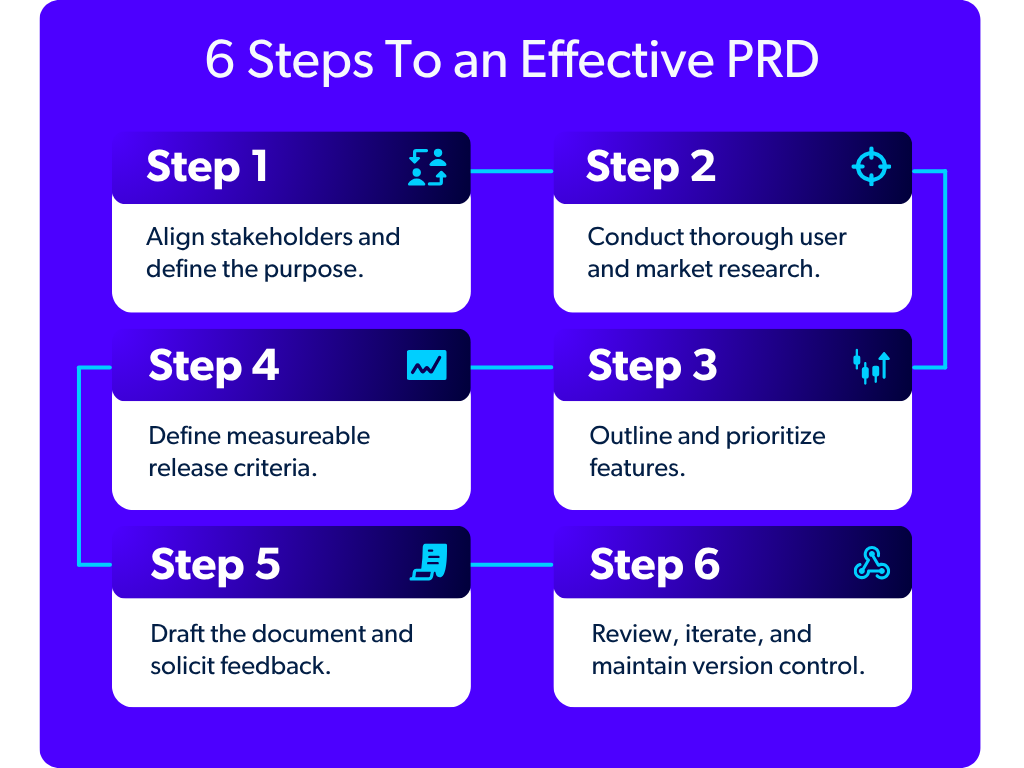
How to Write an Effective PRD in 6 Steps
Writing a PRD should be a collaborative process that synthesizes input from across your organization. By following these six steps, you’ll create a document that leaves no stone unturned:
Step 1: Align Stakeholders and Define the Purpose
Begin by articulating the "why" behind the product. Work with leadership and stakeholders to clearly define the problem it solves along with its strategic importance. Your stated purpose should answer:
- What specific user pain points does this product address?
- Who are the primary end-users and customer stakeholders?
- How will this product create value for both the customer and the business?
Step 2: Conduct Thorough User and Market Research
Ground your PRD in solid research and a deep understanding of its users by taking these steps:
- Interview potential users to understand their needs and workflows.
- Analyze competitor products to identify gaps and opportunities.
- Create detailed user personas that your team can target.
Step 3: Outline and Prioritize Features
With the purpose and user needs defined, break your product down into feature requirements. Structure them hierarchically and set a prioritization framework to determine what to build first:
- Themes: High-level strategic goals that could span several years and across multiple releases (e.g., "Improve Mobile Experience").
- Initiatives/Epics: Large-scale projects that contribute to a theme (e.g., "Launch Native iOS App").
- Features/User Stories: Specific functionalities that deliver value to the user (e.g., "As a user, I want to log in with Face ID").
Additional Resource: From Planning a Theme to Setting Requirements. Watch our webinar to see the process in action.
Step 4: Define Measurable Release Criteria
Set clear, quantifiable goals for your release across five key areas:
- Functionality: Define the "must-have" features required for launch.
- Usability: Set standards for user-friendliness to validate through user test cycles.
- Reliability: Establish requirements for system uptime and error recovery.
- Performance: Set specific benchmarks for speed, responsiveness, and load handling.
- Supportability: Ensure the product can be installed, configured, and maintained by users and internal teams.
Step 5: Draft the Requirements Document and Solicit Feedback
Write the first draft of your PRD, incorporating all the elements outlined in the “10 Core Components” section above and then refine for clarity and precision. Once the draft is ready, circulate it for review.
Using Word or Google Docs to create your PRD can result in lost or duplicated documents and missed feedback when working with large or dispersed teams. The last thing you want is to have multiple stakeholders making comments on different versions of the requirements document and then having to consolidate them. A centralized platform like Perforce ALM simplifies the review process by providing a single source of truth that is continually updated and versioned as users enter their feedback.
Once you incorporate feedback and finalize the document, seek formal sign-off from all key stakeholders.
Step 6: Review, Iterate, and Maintain Version Control
A PRD is not static. It is a living document that evolves as development progresses and new insights emerge. As your product team begins its work, revisit the PRD to ensure it remains aligned with the project's current state. Consider:
- Continuous Review: Regularly review the PRD with the development team to validate assumptions and adjust requirements based on technical findings or market shifts.
- Sprint Iteration: Update the document to reflect changes after sprints. This way, you keep all stakeholders aware of the product's scope and features as it evolves.
- Version Control: Utilize a robust system to manage document versions and track changes. Ensure that the entire team is working from the most current and approved version of the PRD.
Additional Resource: Requirements Management: Tips, Tactics, and Tools. Learn eight best practices for managing your project requirements.
Back to top
Product Requirements Document Examples
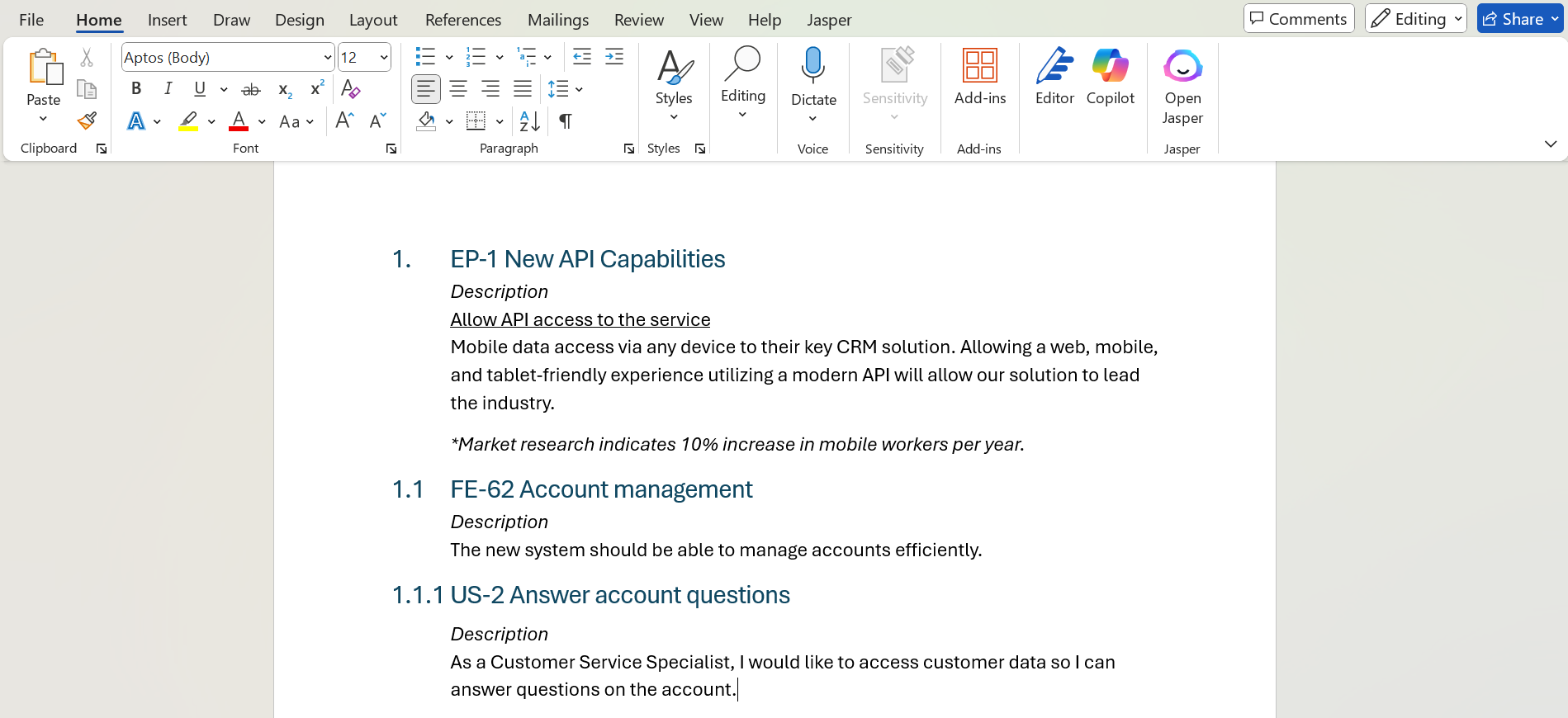
Basic Spreadsheet PRD
Many teams use basic spreadsheet or word processing software to create their PRDs. Below is an example of what a product requirements document might look like in Microsoft Word:
Dedicated PRD Tool
However, keeping a PRD up to date is difficult without a dedicated requirements management tool. How do you ensure everyone has access to the latest version and that all information remains accurate? Collaboration and agility become significant challenges.
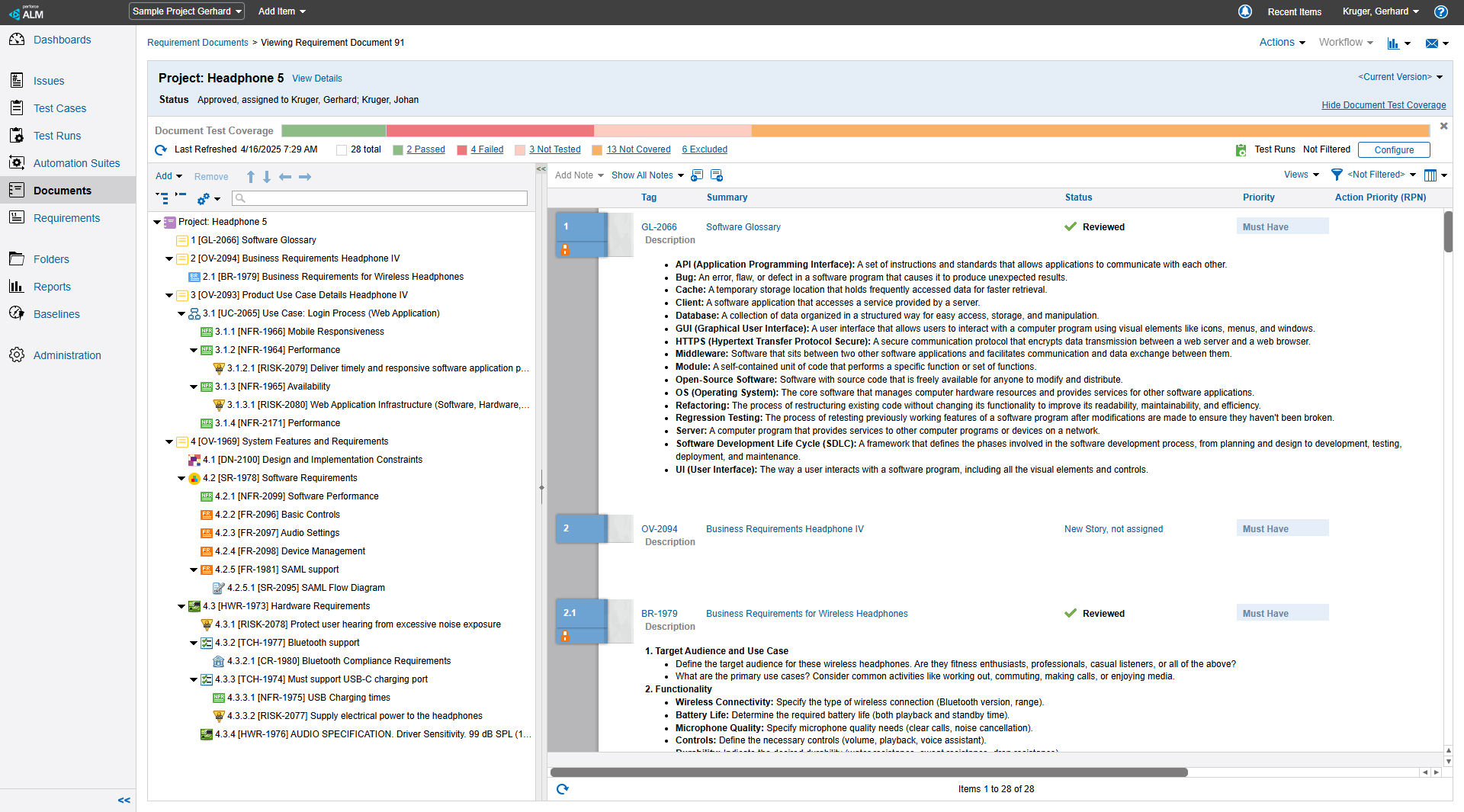
That’s why many development teams use requirements management software to create a PRD. With a proper requirements management tool like Perforce ALM you can eliminate information silos. Everything from your PRD to testing and defect management can be tracked and connected in one place. Your requirements will always be up to date whether you prefer Waterfall, Agile, or hybrid methodologies.
Here is an example of a product requirements document in Perforce ALM:
Agile PRD
You can create an Agile requirements document in a task board. This gives you at-a-glance visibility of all your requirements and their status. For example, on the Kanban board below, you can see how user stories (requirements) are in the process of being reviewed and implemented:
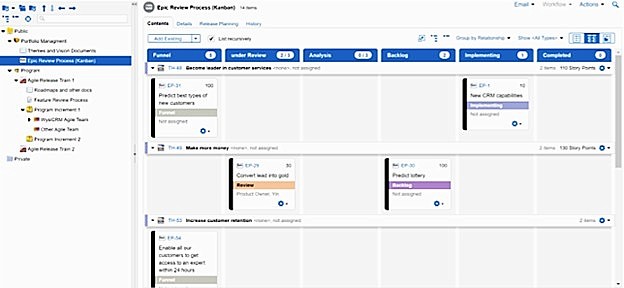
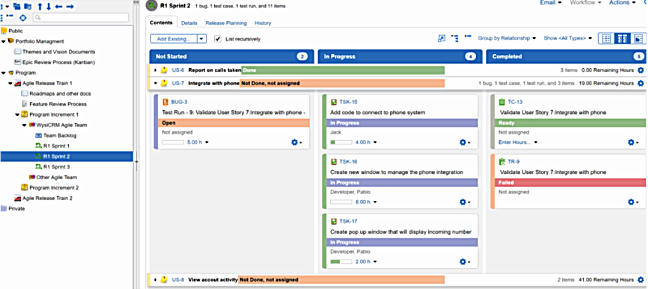
If you’re developing in sprints, like most Agile teams, you can use Perforce ALM to monitor the progress of each sprint. You’ll see which user stories have been implemented and validated, and which are still outstanding.
Back to top
The Role of Traceability in PRDs
Writing a PRD is only the beginning. To ensure a quality product release, you must connect your requirements to every stage of the development lifecycle including testing and issue resolution. This is known as traceability.
With a powerful tool like Perforce ALM, you can achieve end-to-end traceability:
- Link test cases directly to requirements in your PRD to ensure complete test coverage.
- Trace bugs and issues back to the specific requirement and test case they relate to.
- Generate a traceability matrix automatically, providing a real-time, auditable view of your entire development process. Here is an example:
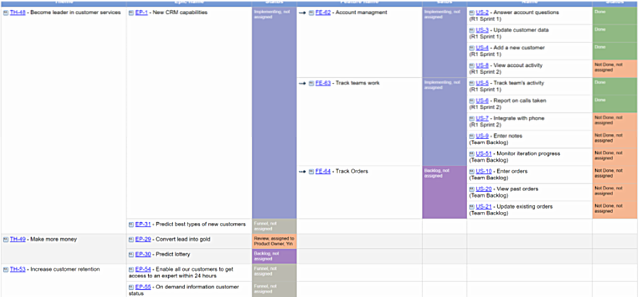
Complete traceability throughout product development ensures that you have built exactly what you planned. You’ll ensure the product functions as intended and that it delivers on its promise to your customers.
Back to topStreamline Your PRD Process with Perforce
Creating and managing a PRD in a conventional document editor is inefficient and risky. Perforce ALM provides a centralized, collaborative solution that:
- Eliminates information silos
- Automates traceability
- Allows you to easily configure any type of workflow (Waterfall, Agile, Hybrid)
- Traces test cases and issues back to requirements
- Accommodates FMEA, ASIL, Hazard Analysis, with built-in risk tracking
- Facilitates compliance with strict cybersecurity mandates
Watch our free 20-minute demo today to see how Perforce ALM simplifies PRD creation and management. You can also see how ALM stacks up against the competition:
Watch Now: PRD Creation Simplified Try Perforce ALM for Free