
Data governance has become a top priority as organizations manage increasingly complex and fast‑moving data environments. Industry research from Liquibase in 2026 shows that enterprises now juggle an average of five database and data platform types. Many manage ten or more. And nearly 70% deploy database changes on a weekly or faster cadence. At the same time, 96.5% of organizations already allow AI or large language models to interact directly with their databases, introducing AI and data privacy concerns.
All this means that data governance is more important than ever, especially as the volume of data continues to increase every year. In 2021, the Aureus Analytics report that projected growth trends from 2021-2026 of 40% per year. If anything, these numbers have been far exceeded, and it's impacting non-production environments too. This risk is not hypothetical: our third annual State of Data Compliance and Security Report found that 43% of enterprises have already experienced audit failures, and 34% have experienced breaches or theft tied to non-production data.
As far back as the early 2000s, enterprises recognized data as a strategic asset of the company to guide strategic decision-making, promote experimentation to learn and improve, and deliver better business results.
But after public data breaches jolted well-known brands like Facebook and Yahoo, data security has become a top priority for enterprises. This led to the demand for regulatory data governance.
Back to topWhat is Data Governance?
Data governance is the set of rules and responsibilities that guide how an organization uses its data.
The Data Governance Institute defines it as a system that decides who can take action on data, what actions they can take, and under which conditions. In short, it explains who does what with which data, and when.
Gartner describes data governance as the processes, roles, policies, standards, and measurements that help an organization use data effectively to achieve its goals.
Together, these definitions show that strong data governance relies on clear data standards and policies. It protects data integrity by defining who can access data, how it can be used, and what methods must be followed.
As new data privacy laws and regulations continue to emerge, organizations need strong and ethical data governance programs. A solid data governance framework clearly defines roles and responsibilities and supports both day‑to‑day operations and long‑term business goals.
Back to topWho is Responsible for Data Governance?
Data governance is a shared responsibility across the entire organization.
In large companies, a dedicated data governance team usually leads the effort. This team sets goals and priorities, designs the governance model, secures budget approval, and selects the right tools and technologies. Below are the most common roles involved in data governance.
Data Owners
Data owners are usually senior managers. They define the organization’s data needs and data quality standards. Their role is business-focused, and they have the authority to make decisions that affect the entire organization.
Data owners are accountable for data as a business asset and for ensuring it is accurate, reliable, and fit for use.
Data Stewards
Data stewards play a more technical role and are often referred to as data architects. They ensure that data standards and policies are followed on a daily basis.
Data stewards are typically part of a central data or IT team. They act as subject-matter experts for specific data domains or data elements. Their responsibilities include defining standard data terms, documenting data flows between systems, and monitoring data quality. They help manage data assets or advise others on how to do so.
Data Custodians
Data custodians, sometimes called data operators, are responsible for creating, maintaining, and updating data according to organizational standards.
Their work includes onboarding new data, making updates, and performing routine maintenance. Data custodians may work within business units or as part of shared services or support teams.
Data Governance Committee
A data governance committee approves data-related policies and standards. It also resolves issues that cannot be handled at lower levels.
In large organizations, this committee may include smaller subcommittees focused on specific areas, such as customers, vendors, products, or employees. These groups help ensure that data priorities and requirements are aligned across the organization. Many organizations also separate governance into strategic and tactical boards to address long-term planning and day-to-day decisions.
Back to topWhy Is Data Governance Important?
Data governance is critical because data risks are no longer theoretical. IBM recently reported that in the U.S. alone, businesses lose $3.1 trillion every year due to poor data quality. This concern only grows as the role of AI increases. In 2026, Liquibase found that 64.3% of organizations identify data quality issues as a leading AI‑related risk, while nearly half worry about ungoverned AI‑generated SQL interacting with production data. Yet only 28.1% report operating at managed or optimized governance maturity levels.
The disconnect is measurable: According to our 2026 State of Data Compliance and Security Report, 86% of organizations report having AI data privacy mandates in place, and 98% feel confident in their ability to protect sensitive data in AI workflows. Yet, 68% remain concerned about data leaks in these environments, and 62% about training data breaches — a clear sign that policy alone isn't closing the gap.
When data quality is low, it affects every aspect of a business. It's impossible to make accurate decisions or take calculated risks when data quality is poor.
Back to top5 Key Benefits of Data Governance
While data governance can take effort to put in place, it helps organizations stay flexible in competitive markets while also meeting changing data privacy laws.
Stronger Data Security
Data security means protecting both the systems that store data and the data itself. Access controls, such as multi-factor authentication, help limit risk, but they are not enough on their own.
Sensitive data, especially personally identifiable information (PII), is still at risk if it is not anonymized. In non-production environments, PII must be masked to meet compliance requirements and reduce the chance of exposure or misuse.
Higher Data Quality
A strong data governance program helps keep data accurate and up to date. Shared ownership ensures data is regularly cleaned, updated, and removed when no longer needed.
Managing data can be time-consuming, but clear processes make it easier. Good data policies reduce redundant, outdated, and trivial information (ROT). This helps eliminate duplicate or incorrect records and creates a single, reliable source of high‑quality data.
Better Decision-Making & Business Planning
Data plays a key role in modern business decisions. Data governance ensures that authorized teams work from the same trusted data.
By removing data silos, teams across IT, sales, and marketing can share insights, collaborate more effectively, and avoid wasted time and effort. Access to consistent data leads to better planning and smarter decisions.
Faster Time-to-Compliance
Strong data governance also speeds up compliance with regulations. Many organizations now use low-code or no-code tools to meet compliance needs faster.
Data governance in the enterprise should include data protection techniques like masking. As a result, organizations can become compliant much more quickly, without months or years of training.
Stronger Data Privacy Compliance
Implementing a data governance system makes it easier for your organization to be 100% compliant with the latest laws, including the European Union's General Data Protection Regulation (GDPR), U.S.' Health Insurance Portability and Accountability (HIPAA), the Payment Card Industry Data Security Standard (PCI-DSS), and more.
Compliance should be a top priority. Data privacy laws continue to evolve, and strong data governance helps organizations stay prepared. Following clear data security policies reduces the risk of fines, legal penalties, and data breaches while keeping sensitive data out of the wrong hands.
ON-DEMAND WEBINAR
Protect Data at Scale with Advanced Strategies
Discover how your enterprise can protect sensitive data in petabyte-scale environments while ensuring GDPR compliance. This webinar dives into AI-driven data discovery, workflow automation, and real-world success stories featuring leading European organizations.
Back to top
4 Challenges of Data Governance
Poor data management makes it hard for employees to find the information they need. On average, users spend nearly two hours each day searching for the right data. This remains a major challenge for many organizations.
Lack of Leadership
Data governance affects many departments, so strong leadership is essential. A successful data governance program needs clear direction from senior leaders and strong collaboration across teams.
Many organizations now recognize data as a strategic asset. Some have created senior leadership roles focused on data, such as Chief Data Officers (CDOs). If a company does not have this role, it still needs a senior leader who owns data policies and processes. This leader must advocate for budget, resources, and accountability to make data governance effective.
Lack of Team Support
Organizations often struggle with data governance when too much responsibility falls on data scientists alone. While data scientists are skilled at analyzing data, data governance also includes tasks such as setting policies, defining standards, and managing compliance.
Data governance works best when multiple stakeholders share responsibility. These stakeholders manage different parts of data operations and ensure regulatory requirements are met.
Poor Understanding of Data Value
Many organizations lack clarity around who owns data, who can access it, and how it should be used. As a result, data is often stored in systems that are inaccurate or outdated.
This leads to redundant, outdated, and trivial data (ROT), which creates ongoing problems and reduces trust in data. Technology alone cannot fix this issue. Data must be understood, managed, and governed properly before it can deliver value.
Poor Data Management
Data management and data governance are not the same. Data governance defines the rules, while data management puts those rules into action.
When data management is weak, organizations face issues such as unsecured data, unclear processes, data silos, and limited control. Without consistent policies and processes, organizations increase their risk of data breaches and regulatory non-compliance.
Back to topWhat to Look for in Data Governance Tools
As data becomes more critical to business success, organizations rely more on data governance tools to protect and manage their data assets.
Most data governance tools help organizations achieve:
- Better decision-making.
- Improved data quality.
- More efficient data management.
- Greater data sharing and interoperability.
- Clear data lineage and tracking.
Choosing the right tools starts with understanding your data governance goals. Tools work best when they support a clear strategy and well-defined objectives.
Back to top3 Successful Examples of Governing Data for Compliance, Quality, & Speed
Here at Perforce Delphix, we work with enterprises with complex data governance, compliance, and security demands. Time and time again, we find that they can have it all: governed data for compliance WITH quality and speed of development. They just need to choose the right DevOps Data Platform.
Molina Healthcare Gained HIPAA Compliance & Development Speed
Molina Healthcare needed to adhere to strict data privacy and security regulations, including HIPAA. By using Delphix, they ensure data compliance while accelerating projects by 50%.
Sky Italia Achieved GDPR Compliance in 5 Months
Sky Italia chose Delphix to help them achieve full GDPR compliance in five months. On top of that, they reduced their infrastructure footprint by 90%!
UniSuper Secured Sensitive Data & Increased Efficiency by 70%
UniSuper chose Delphix to help them mask sensitive PII for compliance. By doing so, they also gained 70% in development team efficiency and reduced database environment refresh times from 6 hours to less than 60 minutes.
Back to topHow Delphix Supports Data Governance
Data governance matters everywhere data lives. Not just in production. Yet non‑production environments like development, testing, AI, and analytics often lack the same controls, even though they frequently contain sensitive data such as personally identifiable information (PII).
Delphix strengthens operational data governance for non‑production by automating how data is discovered, protected, delivered, and controlled. Sensitive data is identified and irreversibly masked before it’s shared, ensuring teams can work with production‑like data without exposing real PII or increasing compliance risk.
By automating data delivery, refresh, migration, and recovery, Delphix removes manual processes that introduce risk and errors. Teams gain centralized visibility and policy‑based control over non‑production data, improving auditability while enabling faster, safer innovation.
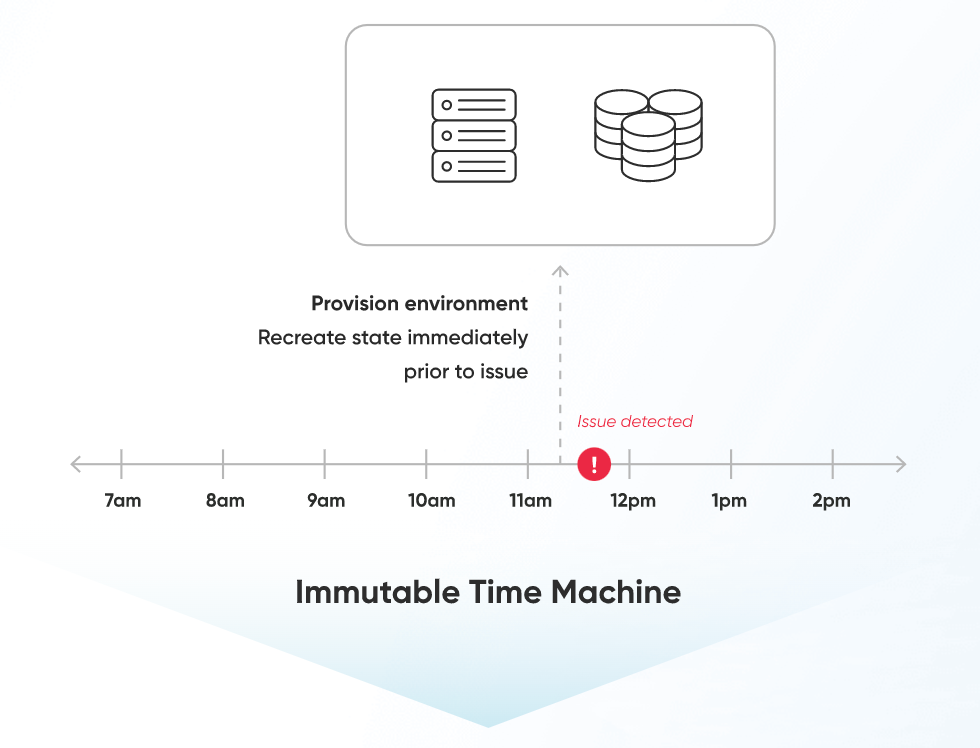
Delphix also provides continuous data capture and immutable versioning, preserving granular data history down to the second. This enables rapid recovery to a precise point in time and helps organizations reduce downtime and limit the blast radius of ransomware or data corruption events.
Back to top
Why Delphix for Data Governance?
Reduced Risk Through Automated Data Protection
Delphix automatically discovers sensitive data and applies irreversible masking to eliminate exposure in non‑production environments. Built‑in controls, immutable versioned data, and continuous change detection help organizations reduce privacy, security, and ransomware risk while maintaining full data integrity.
Consistent, Scalable Compliance
Centralized, policy‑based governance ensures data protection standards are applied consistently across all non‑production environments. Delphix supports compliance requirements such as GDPR, HIPAA, and PCI DSS without slowing teams down or relying on manual enforcement.
Trusted Data for DevOps, Analytics, & AI
Delphix combines masking, automation, and data delivery to provide secure, high‑quality datasets for development, testing, analytics, and AI initiatives. Teams get fast, self‑service access to trusted data — without copying sensitive information or increasing storage costs.
REQUEST DEMO
Take Control of Your Data Today
Try Delphix data masking and see how Delphix enables fast, automated compliance. Request a no-pressure compliance demo today. You’ll find out why industry leaders choose Delphix to mitigate data risks and accelerate innovation.