
Blog
August 5, 2026
Sovereign by Design: Why AI Turns Data Sovereignty From Principle Into Foundation

Data Management,
Security & Compliance
Sovereignty is no longer a compliance debate. It is the operating condition for running data and AI in production.
89% of organizations in our 2026 survey of 320 enterprises rate data sovereignty as very or rather important. Only 38% have governance mature enough to survive a real AI production incident. That is the gap. It sits exactly where data and AI architecture meet enterprise control, and it is the central tension of the year.
Sovereignty is not the opposite of speed. It is the precondition for delivering trusted data at the speed AI demands.
Why does the gap matter more in 2026 than in 2025? Three shifts at once. Sovereignty's "very important" rating jumped from 42% to 51% in twelve months. Organizations moved data and AI into core business processes. And the conversation moved with them: from rules to risk, from policy to architecture, from data at rest to AI in production. Recognition alone does not deliver control.
Back to topWhy Sovereignty Became Unavoidable
Figure 1: Which external factors have made data sovereignty more relevant for your company? Top 5. n2026=316 / n2025=293
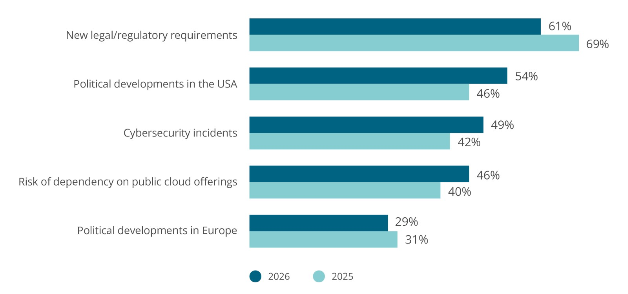
The external driver mix has shifted. Legal and regulatory pressure still leads, but its share dropped from 69% to 61%. Cybersecurity incidents climbed from 42% to 49%. Concern about public-cloud dependency rose from 40% to 46%. Political developments in the US moved from 46% to 54%. Compliance is no longer the only story. Risk and dependency now sit next to it, and they pull sovereignty into enterprise architecture and resilience planning, not just governance committees.
Internally, the picture is sharper. 62% name the increased use of data and AI in core business processes as the reason sovereignty gained relevance. 52% cite growing data sensitivity. 49% point to rising dependency on specific technology or cloud providers. Once AI and data leave the lab and start informing real decisions, the tolerance for unclear control boundaries collapses.
Back to topWhy Ambition Outruns Execution
Figure 2: Please rate your organization’s maturity in the following aspects of data sovereignty. n=317
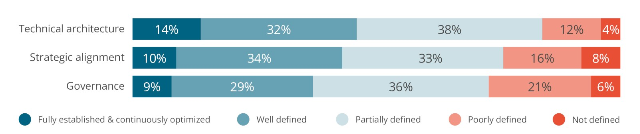
Maturity tells the uncomfortable part of the story. Technical architecture sits at 46% well-defined or fully established. Strategic alignment at 44%. Governance at 38%. A narrow band. Governance the weakest link. The headline ranking is misleading on its own. The sharper signal shows once you split the field by how seriously sovereignty has been anchored.
Two groups, one pattern. Among the 29% who treat sovereignty as a core part of their data or digital strategy: 81% mature strategic alignment, 70% mature technical architecture, 68% mature governance. Among the 14% that do not address it systematically: all three dimensions collapse into single digits. Strategy, architecture, governance move in lockstep. Up for the Doers. Flat for the Talkers.
The wider picture confirms it. 62% of organizations name sovereignty in their strategy in some form. Only 38% have governance maturity to match.
Declaring sovereignty is cheap. Operationalizing it is not. Sovereignty programs that stop at strategy decks rarely survive the first AI production incident.
The lesson is consistent. Strategy work is the easy part. Governance and architecture maturity require operationalization: decision rights, control standards, reusable patterns and the engineering discipline to apply them consistently. Without that step, sovereignty stays a slide.
Back to topWhy This Breaks First in the Data and AI Layer
The biggest shift between 2025 and 2026 is not human. It is technical. Technical hurdles jumped from 26% to 43%. Legacy integration is named by roughly one in three organizations. People still lead the challenge list, with 44% citing lack of resources and over a third citing missing expertise. But the technical surge is the real story. Once sovereignty becomes implementation work, legacy systems, data pipelines and integration patterns stop being abstractions.
This is where the 62% who name data and AI as the dominant driver collide with the 43% who hit technical walls. AI inherits the sovereignty profile of the data it consumes and the platform it runs on. Host a model in a regional data center, and you still lose sovereignty if the underlying data layer, lineage and key management remain outside your control. Sovereign AI is not a model question. It is a data and architecture question. That is where most programs quietly stall.
And it stalls earlier than most teams admit. The operative front line is not the production system. It is the non-production, test and training data flows that feed every model, every release, every analytical workload. That is where lineage, masking and access control either get enforced before the first model run, or never get enforced at all.
The dividing line in 2026 is not who has a sovereignty policy. It is who has a sovereignty operating model.
Back to topWhat Sovereign by Design Means in Practice
Sovereign by Design means securing three things at once: Trust through lineage and auditability, Control through access management and key ownership, Resilience through deliberate workload placement and exit options. These are not separate workstreams. They are the three properties any production AI workload must inherit from its data foundation.
Four operating principles separate the doers from the talkers in our data. They only work as a sequence:
- Fund it as a program, not as a footnote. Organizations with dedicated budgets report 75% well-defined strategic alignment and 71% positive impact on innovation. Treat sovereignty as a line item: scope, ownership, measurable outcomes. Without funding, the next three principles collapse into intention.
- Design data and AI workflows for sovereignty from day one. With 62% naming data and AI as the dominant internal driver, lineage, access control, auditability and trusted data delivery stop being optional. AI-ready data is data that can prove where it came from, who touched it, and where it is allowed to live. This is the core of Sovereign by Design. It is where the program either becomes architecture, or stays a deck.
- Automate trusted data delivery. Sovereignty is not decided in policy meetings. It is decided in the pipelines that feed every test, training and analytical workload with compatible, masked, lineage-aware data. With 43% citing technical hurdles and one in three naming legacy integration as the bottleneck, manual data preparation no longer scales with sovereign AI. Whoever automates trusted data delivery turns governance and architecture from a slideware promise into a repeatable engineering pattern.
- Treat hybrid and multi-cloud as the default operating model. 35% are strengthening hybrid cloud and on-premises strategy. 26% are reinforcing multi-cloud. 29% are turning to regional or local providers. On-premises use grew from 19% to 24%. Repatriation doubled from 8% to 16%. This is not a retreat from cloud.
Deliberate placement is the operational expression of sovereignty.
Workloads sit where their control profile demands, not where the default contract puts them. Without that discipline, sovereign AI stays a lab exercise.
Back to topThe Year Sovereignty Stops Being Optional
76% of organizations expect data sovereignty to keep gaining importance. Almost nobody expects a decline. The next twelve months separate two groups. One group operationalizes sovereignty by design: funded programs, real governance, an AI-aware data foundation. The other keeps documenting it by intention. The shortest path between the two runs through the data layer that already exists. Lift today's DevOps and test data management discipline to a sovereignty standard, and the foundation on which AI in production scales tomorrow is already built. Only the first group will scale AI on data they actually control.
Sovereign by Design, or sovereign by accident. Pick one.
REQUEST DEMO
Operationalize Sovereignty with Trusted, AI-Ready Data
Perforce Delphix delivers fast, compliant, AI-ready data environments on demand — helping enterprises operationalize governance, prove control, and scale AI-driven delivery.
Accelerate AI-Driven Delivery
- Deliver trusted data at AI speed: Remove data bottlenecks with automated, on-demand delivery.
- Enable agentic workflows: Provide self-service, production-like compliant data for developers, testers, and AI agents.
- Expand coverage with synthetic data: Generate data for new features and edge cases.
Govern Data Trust & Compliance
- Protect sensitive data across environments: Automatically discover, mask, and govern data across DevOps, AI, and analytics.
- Prove compliance with control and auditability: Enforce centralized policies with full traceability.
Scale Efficient Data Environments
- Deploy anywhere: Deliver virtual, ephemeral data across hybrid and multicloud environments.
- Reduce cost and complexity: Eliminate excess copies with space-efficient data delivery.
See How Delphix Supports Data Sovereignty
See how Delphix lets you deliver trusted data, enforce control, and scale AI with confidence. Request a custom demo today.