
Blog
May 5, 2026
Establishing a Multicloud Data Strategy for the AI Era


Data Management,
DevOps,
AI
In my experience working with enterprise leaders, the journey to the cloud rarely follows a straight line. Many organizations set ambitious goals to move all operations to the cloud. They quickly find that certain legacy systems must remain on-premises.
This reality results in a complex, hybrid multicloud environment. That means they need to adopt a new strategy for managing test data. Enterprises have to navigate the challenges of integrating old and new, balancing innovation with the demands of legacy infrastructure.
You might already split modern workloads on AWS or Azure using their compute and platform services. At the same time, you may need to keep core legacy databases firmly on-premises. To make matters worse, there might be a different combination across your many geographies.
This kind of fragmented landscape presents significant bottlenecks and complex administrative overhead.
To accelerate application delivery and pursue digital transformation, you need fast, trusted, AI-ready data — accessible across all your environments.
Back to topThe Realities of Modern Cloud Architectures
The shift to multicloud architectures brings immense flexibility. However, it also introduces deep complexities for your data orchestration teams.
Why Do Hybrid States Persist in Cloud Strategies?
I regularly speak with organizations attempting to fully abandon their on-premises infrastructure. Inevitably, they encounter significant obstacles. Certain legacy applications have intricate dependencies and are either too complex or too costly to migrate.
As a result, organizations have to support both traditional on-premises databases and modern cloud deployments at the same time. In this landscape, data silos are common and hinder agility.
Why Are Non-Production Environments Left Behind in Cloud Transformation?
In my experience, as production applications advance in the cloud, non-production environments do not necessarily reap the same benefits. Too often, environments are shared across many dev teams to save costs, static long-lived test environments are forgotten, and incomplete testing occurs due to limited orchestration with legacy databases.
Transforming these non-production environments is essential. By focusing on modernization here, you unlock the true value of both hybrid and multicloud strategies. Agile, automated, and up-to-date test environments are a critical factor in meeting business demands.
How to Handle Heterogeneous Sources
Operating in a multicloud environment means dealing with diverse data sources. For example, you may have an on-premises Oracle database, a PostgreSQL instance running on AWS, and a Snowflake environment used for analytics.
Each platform comes with its own unique interface, security protocols, and methods of connection. These differences can become major hurdles for IT and development teams.
Modern automation can help overcome these obstacles:
- Kubernetes-native automation: Spin up containerized databases in seconds.
- Rapid environment provisioning: Quickly provision or clone test environments without manual intervention.
- Improved efficiency: Reduce the time your developers spend managing infrastructure, so they focus more on writing code.
- Isolated and coordinated deployments: Provision safe copies of these data sets in isolation or as a coordinated group.
Without these advances, teams waste valuable time wrestling with infrastructure chaos. Embracing automation strategies lets you maintain agility in a heterogeneous cloud landscape.
Back to topWant to Become a Modern, Cloud-Driven Enterprise?
If you're balancing on-premises and cloud data, watch this recent webinar from myself and Daniel Stolf. You will learn how to best optimize your test data management between environments and save on storage costs.
How to Address New Threats to Your Multicloud Estate in the AI Era
AI transforms how we interact with information. While this brings incredible speed to development, it also introduces serious data privacy and compliance risks.
What Risk Does Agentic AI Pose?
Agentic AI tools scan massive swaths of data at speeds no human can match. When you connect an AI agent to your corporate environment, it identifies information that human workers may have forgotten even exists — or unknown security holes.
This speed and thoroughness introduce a major new attack vector. If sensitive production data leaks into non-production environments, an AI agent could surface private information during a simple, routine query.
The risk of unintentional exposure increases drastically as AI-driven automation becomes standard and you further split your data across on-premises and cloud.
According to Perforce Delphix's 2026 Test Data Management Report for AI-Ready Enterprises, 57% of organizations report an increase in sensitive data volume across non-production environments over the past 12 months, compounding the challenge for developers, testers, and AI agents operating at scale.
How to Secure Sensitive Information?
To innovate with confidence, you must eliminate sensitive data risk across all multicloud environments. Delphix automatically discovers and protects sensitive data through automated data masking and policy-based governance.
By centralizing control, you reduce regulatory risks and ensure compliance with strict privacy laws like HIPAA and GDPR. Downstream teams can access fresh, high-quality masked data on-demand.
Back to topBuilding a Unified Data Fabric: Where an Enterprise Test Data Management Platform Becomes Critical
Enterprises cannot solve modern data challenges with a patchwork of point tools. You need a single, secure platform that unifies data delivery, governance, and compliance.
How Can You Orchestrate Data Across Environments?
As applications span on‑premises systems, public cloud, and managed services, data orchestration directly affects delivery speed. Teams need reliable access to data at every stage of development. Without a coordinated approach, fragmented data, slow refresh cycles, and inconsistent environments quickly become a bottleneck.
Perforce Delphix's 2026 Test Data Management Report for AI-Ready Enterprises found that 99% of organizations wait longer than one business day for a fresh full production copy of test data, and 42% wait weeks or months. At that pace, development teams cannot validate AI-generated code fast enough to keep delivery cycles competitive.
To manage this complexity at scale, enterprises need a centralized way to coordinate data delivery, consistency, and control across all environments.
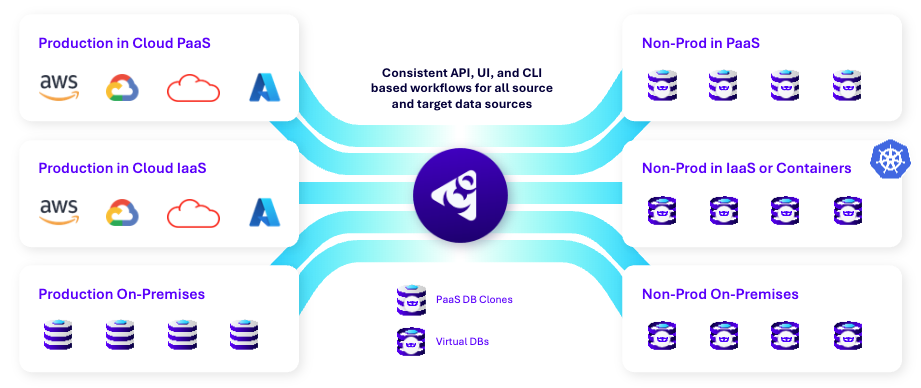
Perforce Delphix is the intelligent data automation platform built for enterprise scale and complexity. Delphix creates a unified data fabric that seamlessly spans on-premises systems, cloud infrastructure, and PaaS environments.
Whether your data lives in a legacy Oracle database or a cloud-native Databricks environment, Delphix gives you a single point of control. You can refresh, rewind, bookmark, and branch data through a variety of simple interfaces, such as an MCP Server.
How to Supply AI-Ready Data?
To speed up scenario testing and unblock new development, your teams need highly accurate test data. That data must be realistic, safe to use, and available on-demand as AI-driven workflows place more pressure on non‑production environments.
With Delphix, teams combine automated masking with secure synthetic data generation. They can deliver production‑like synthetic data alongside masked copies to cover rare edge cases while preserving referential integrity across databases and warehouses.
Further reading >> Why Enterprises are Rethinking Their Test Data Management Practices in the AI SDLC
Get a Demo
Simplify Multicloud Data Management with Perforce Delphix
Delphix offers an intelligent data automation platform that delivers fast, trusted, AI-ready test data across hybrid and multicloud environments.
According to IDC Research, Delphix users achieved a 408% 3-year ROI and a 58% faster time to develop applications.*
Related Reading >> What is Perforce Delphix?
Ship Faster with On-demand Test Data
- Virtualize your data: Provide compliant, production-quality test data to your teams in minutes.
- Accelerate delivery: Companies like Mattel reduced database refresh times from 5 days to 4-8 hours.
- Automate pipelines: Use data APIs to refresh, rewind, and branch data directly within your DevOps workflows for rapid release cycles.
- Speed up testing with synthetic data: Bolster your existing masked data with AI-powered, customizable synthetic data to test performance.
Innovate with Confidence
- Ensure compliance: Maintain referential integrity at scale with built-in security, auditability, and advanced data discovery.
- Mitigate risk: Companies like Mizuho Securities automate test data management to secure sensitive financial records while cutting delivery time by 90%.
- Protect sensitive information: Delphix users mask and protect 77.2% more data and data environments* with automated, policy-based protocols.
Cost-Efficient, Cloud-Ready Test Data
- Reduce storage costs: Benefit from space-efficient virtual data copies that drastically lower your infrastructure footprint.
- Optimize spending: Deploy ephemeral, self-service environments to manage data costs across cloud, hybrid, and on-premises systems.
Watch how it works:
See Delphix in Action
See for yourself how Delphix can make multicloud data management more efficient and secure by streamlining the delivery of compliant, high-quality test data at scale. Request your personalized demo today.

Get the Report
Your Peers Have Spoken.
Perforce is a Customers’ Choice in the Gartner® Peer Insights™ 2025 Voice of the Customer Report for Test Data Management (TDM).*
Gartner, Gartner Peer Insights Voice of the Customer, Test Data Management, Peer Contributors, 30 July 2025,
Gartner, Peer Insights and the Gartner Peer Insights Customers' Choice badge are trademarks of Gartner, Inc. and/or its affiliates.
Gartner Peer Insights content consists of the opinions of individual end users based on their own experiences, and should not be construed as statements of fact, nor do they represent the views of Gartner or its affiliates. Gartner does not endorse any vendor, product or service depicted in this content nor makes any warranties, expressed or implied, with respect to this content, about its accuracy or completeness, including any warranties of merchantability or fitness for a particular purpose.
*IDC Business Value White Paper, sponsored by Delphix, by Perforce, The Business Value of Delphix, #US52560824, December 2024
This blog was originally published by Matt Yeh and has been updated by Nick Mathison.