
Blog
February 23, 2026
How Ephemeral Data Can Save You Time, Money, & Cloud Storage


Data Management,
DevOps
I've lost count of how many times I've heard some version of this story: A development team needs to spin up a new environment for testing, but the request often sits in a queue for days — sometimes weeks — while infrastructure teams wrestle with storage constraints and provisioning bottlenecks.
By the time the environment is ready, priorities have shifted, sprint deadlines have been missed, and the team that requested it is already firefighting the next production issue. The kicker? That test environment, once provisioned, often sits idle for months, quietly consuming cloud resources and inflating storage costs.
Ephemeral data helps solve all these problems, from its provisioning to its removal when you no longer need it. In this blog, I’ll share how ephemeral data works, the best use cases for it, and the benefits you reap from adding it to your data operations. Let’s dive into all things ephemeral data!
Back to top
What is Ephemeral Data?
Ephemeral data is lightweight, temporary information created and used for short-term tasks in apps or systems. It’s used while it’s needed, and it’s removed when it’s no longer needed.
Take testing environments, for example. In most enterprises, developers and quality assurance (QA) engineers rely on static, pre-built environments that may periodically get refreshed or updated. These users can instead use ephemeral data to mimic real-world conditions, then delete it once testing is complete.
Back to topEphemeral Data vs. Persistent Data
The main difference between ephemeral data vs. persistent data is the storage timeframe. Ephemeral data is stored for short-term use, while persistent data is stored for long-term use and frequent reuse. Here are a few other qualities of each.
Key Characteristics of Persistent & Ephemeral Data
Persistent Data
The key characteristics of persistent data are:
- Long-term lifespan: Persistent data survives reboots, system shutdowns, or crashes.
- Persistent storage: It is stored on hard drives, SSDs, physical databases, or data lakes, making it accessible even after the creation process ends.
- Reliable: Designed to be durable and available, persistent data usually includes backup solutions to prevent data loss.
- Broad use cases: Examples include production databases, User Acceptance Testing (UAT) environments, and hot standby databases.
Ephemeral Data
The key characteristics of ephemeral data are:
- Short lifespan: It only lasts for a short time, such as during one transaction or session.
- Non-persistent: Data may not be stored permanently, saving on storage costs and reducing security risks.
- Scalable and flexible: It allows compute environments to expand or shrink based on needs.
- Secure: Its temporary nature helps reduce exposure to sensitive data.
Benefits of Persistent vs. Ephemeral Data
The reality is that most enterprises should use both ephemeral and persistent data. There will always be use cases for persistent data. You can’t run production ephemerally, although it’s possible to incorporate ephemerality into micro-services requiring point-in-time access to production-like data.
But there are times when your organization can and should use ephemeral data to save on cloud resources. This type of data enables you to build cloud infrastructure or utilize purpose-built DevOps container tools like Kubernetes, and load datasets to it in minutes. Use it. Terminate it when it’s done — without losing anything.
Ephemeral data environments help you save on cloud costs too, since you build and break down these environments at will and won’t have to spend as much storing large amounts of persistent data.
In this quick demo, my colleague Grant Ward shows you how Delphix ephemeral data environments help you save money on cloud storage:
Most enterprises that I work with find that Delphix reduces costs by 30–50%. And a recent IDC white paper — The Business Value of Delphix — found that enterprises can recognize $8.4 million in additional revenue from improved software development team productivity, as a result of automating data and reducing infrastructure costs.
Back to topPersistent vs. Ephemeral Data Use Cases
The question isn't persistent versus ephemeral; it's understanding what each is optimized for. Persistent data excels where stability, auditability, and accumulation matter:
- Production databases serving customers
- Disaster recovery systems
- Performance baselines that require like-for-like environments
- Data warehouses in which value compounds with history
Ephemeral data, on the other hand, shines where speed and cost-efficiency trump longevity:
- Short bursts/sprints for development and QA
- Feature development
- Bug reproduction
- Training environments
How to Automate Ephemeral Data Provisioning with Perforce Delphix
Modern app development needs to be fast, flexible, and precise, and manual processes are often riddled with data bottlenecks. That’s why automation is so important, especially for setting up ephemeral data environments.
With Perforce Delphix, your IT and application development teams can speed things up and work more efficiently by automating these setups. What’s more, you can have the best of both worlds: persistent, highly compressed data storage that can be made available in minutes for ephemeral use-cases and torn down just as fast.
Why Automate Ephemeral Data Environments?
Developers and QA teams need non-production environments that are as close to real production systems as possible to test things properly. But creating these environments manually takes too much time, leads to mistakes, and uses up too many resources.
According to the Perforce Delphix 2026 Test Data Management Report for AI-Ready Enterprises, 99% of organizations are waiting longer than one business day for a fresh full production copy of test data — and 42% are waiting weeks or months.
Only 1% get their data when they actually need it, which means developers and QA teams often resort to using outdated data. Stale development and QA environments kill productivity and make it easier for bugs to slip through the release process, all while costing your organization more money to always keep them alive.
How Delphix Facilitates Ephemeral Data Environments
Delphix uses virtual database technology alongside automation to create entire downstream environments in just minutes. Using cloud automation or Kubernetes, Delphix can provide full, realistic, compliant database environments of any size for development and testing.
Advanced APIs and pre-built integrations also connect easily to CI/CD pipelines, letting teams quickly set up, bookmark, rewind, and tear down these environments on demand. This not only saves time but also ensures resources are only used when needed.
Here’s how Delphix can integrate into your DevOps workflows to make the process more efficient:
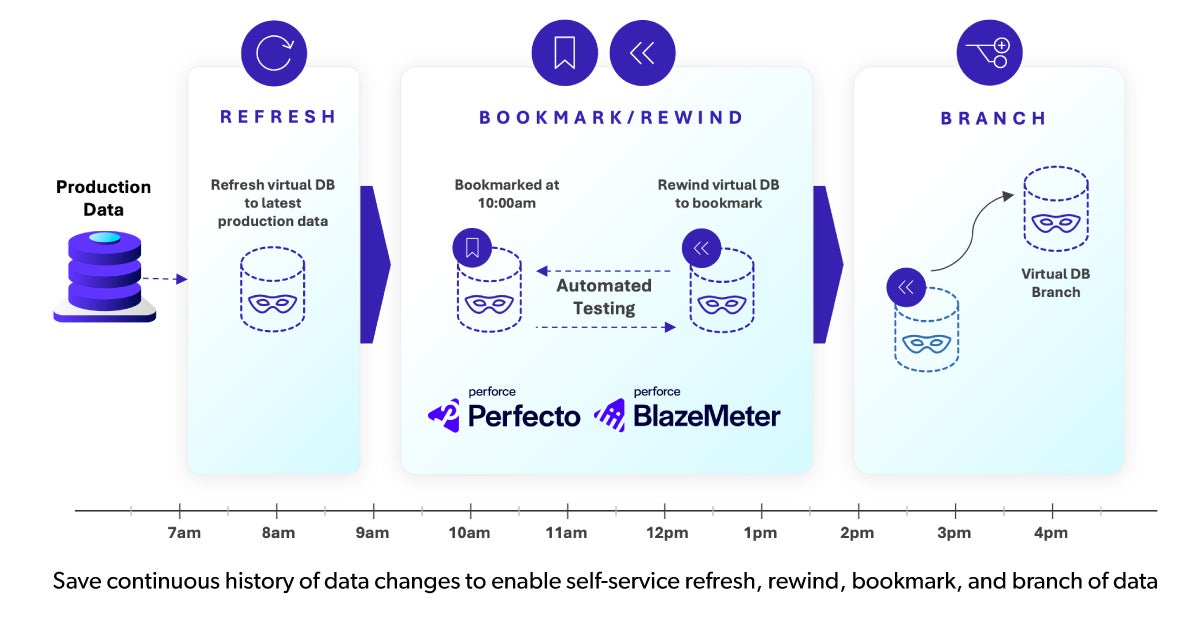
With Delphix, teams can skip the delays of manual processes and focus on delivering better software faster — all while keeping data secure and well-managed. There's no need for DevOps bottlenecks.
WEBINAR
Want to See Ephemeral Data in Action?
In our recent webinar, Delphix experts Daniel Stolf and Matt Livermore break down why ephemeral data is vital for cloud storage, its associated costs, and the efficiency of your CI/CD pipelines. Watch their insightful presentation and demo, to realize the benefits for yourself.
Back to top
6 Best Practices for Ephemeral Test Data Management
Managing test data effectively is a huge challenge for many organizations. According to Perforce’s annual State of Continuous Testing Report, 64% of organizations struggle with the manual effort required to manage test data, while 39% report issues with incomplete test data. The 2026 Test Data Management Report for AI-Ready Enterprises reinforces this further: 39% of enterprises identify data quality or validity issues as their top test data challenge. These challenges are compounded by concerns about integrity and compliance, all of which underscore the need for better test data management strategies.
One of the most promising solutions to these challenges is ephemeral test data environments. These are short-lived, production-like environments generated temporarily for testing purposes. Their temporary nature ensures that environments are clean, standardized, and disposable — reducing the risk of data breaches, simplifying compliance with regulatory requirements, and improving the developer experience.
Automate Creation & Destruction of Ephemeral Data
Spinning up an ephemeral environment shouldn’t require a ticket or manual steps. You should automate the creation and destruction of your ephemeral data, to achieve true ephemerality and manage your temporary environments with ease.
Delphix meets your teams where they already work, with native integrations across the modern delivery stack:
Terraform: Provision and tear down VDBs as part of your infrastructure-as-code workflows, no manual steps required.
ServiceNow: Enable self-service data provisioning directly from your ITSM service catalog.
Jenkins: Hook VDB creation and destruction into your CI/CD pipelines for a fresh, isolated environment on every run.
Puppet: Serve QA security profiles and select the right environments through your infrastructure automation layer.
BlazeMeter: Pair ephemeral data with continuous testing to simulate multiple QA scenarios at scale.
Kubernetes: VDBs provisioned as ephemeral containers inside your existing clusters, spun up in seconds, destroyed automatically, managed declaratively like any other Kubernetes resource.
Tie the Ephemeral Data Lifecycle to Purpose
Test runs with ephemeral data should be temporary and automatically disposed of once it’s served its purpose. If you can't articulate why an ephemeral environment still exists, it shouldn't.
The cleanest way to enforce this is to bind your environments to your feature development lifecycle. Every feature has a clear arc — it's built, tested, and shipped. Your ephemeral data environments should mirror that exactly:
Provisioned when work begins.
Available throughout development and testing.
Automatically torn down when the feature is done.
With automation, there’s no manual cleanup, no stale data accumulating in the background. Just dynamic environments that live and die with the work they support.
Refresh Ephemeral Data Frequently
Ephemeral data doesn't mean stale data. Environments should pull fresh data snapshots regularly — daily for active development, on-demand for specific test scenarios.
Build Guardrails, Not Walls
Developers should self-serve environment creation without waiting for approvals, but with certain parameters including automated controls around data masking, resource limits, and cost budgets. This will ensure you check all the necessary boxes while keeping your process moving smoothly. Delphix makes this operational through a layered set of controls:
Continuous Compliance ensures sensitive data is automatically masked before it ever reaches a developer environment — no manual review required and no risk of exposure.
Data Control Tower gives platform and security teams centralized visibility into who has access to what data, across every environment, and lets you define fine-grained policies around who can provision what (by team, role, environment type, or data sensitivity), so self-service stays within boundaries without requiring a human approver in the loop.
And with selective data distribution, teams only get the subset of data they actually need for their work, reducing both blast radius and infrastructure cost.
Ensure Compliance
Immutable data stores, like those provided by Delphix, play a crucial role in maintaining compliance while handling ephemeral test data. Delphix ensures that data cannot be altered, changed, or accessed without creating a secure target environment. The target environment’s changes are private to that environment and cannot alter source data, safeguarding sensitive information related to GDPR and HIPAA. Ephemeral data, being temporary, also narrows the window of opportunity for unauthorized access or data breaches.
Measure What Matters
Track ephemeral data environment lifespan, provisioning time, and cost per environment. If your averages are trending up, your ephemeral strategy is drifting toward permanent — which defeats the purpose of ephemeral data.
WHITE PAPER
IDC: The Business Value of Delphix
Analyst study of customers shows that the Delphix DevOps Data Platform delivers a 408% 3-year ROI. Discover the tangible benefits of Delphix, validated by IDC analysts.
Back to top
Ephemeral Environment Success Stories
I've seen teams provisioning three or four static test environments with data that no longer reflects production.These environments live for months and edge cases have evolved, and tests pass against scenarios that haven't existed in weeks.
With ephemeral data, they transitioned to spinning up dozens of ephemeral environments daily — each oneautomatically refreshed with realistic data and destroyed when it’s no longer needed.
The shift isn't just operational; it changes how developers work, how fast teams ship, and how confident they feel that their code will behave in production.
Our customers share clear, money-saving results:
- Proximus saved £7 million over 3 years in testing labor.
- Express Scripts saved $1.6 million in cost avoidance
- Cal State University saved $2 million in development storage.
- Mizuho Securities saved $700,000 in labor costs each year.
When it comes to automation, the savings are just as clear:
- Mattel reduced man hours by 600% and reduced the database size by 8 TB.
- Sky Italia saw a 90% reduction in infrastructure footprint and a 30% reduction in operating costs.
- Gain Capital increased business output by 20%.
Get Demo
Delphix Automates Ephemeral Data Delivery
Legacy approaches to data delivery often involve manual processes that take days or weeks, creating bottlenecks in critical DevOps, test data management, analytics, and AI projects. Delphix automates these processes and delivers secure application data in just minutes.
Related blog >> What is Delphix?
Virtualization Transforms Data Delivery Speed, Storage
Delphix syncs with production data sources then instantly provisions space-efficient virtual data copies for non-production use cases, both on-premises and in the cloud. Rather than making and moving new data blocks, Delphix intelligently shares common data blocks across downstream environments over the network. The result? Delphix accelerates provisioning times by 100x while reducing storage footprints by 10x.
Explore Delphix for virtualization >>
Integrate Data Masking with Data Virtualization
The Delphix DevOps Data Platform combines masking with virtualization to deliver compliant data to downstream environments. Delphix masking discovers sensitive values and then irreversibly transforms those values into realistic yet fictitious equivalents for protection against breach and compliance with privacy laws such as GDPR, CCPA, HIPAA, or PCI DSS.
Fast, Compliant Ephemeral Data Delivery
Try Delphix and see how advanced data virtualization and data masking accelerate innovation. Request a no-pressure demo today. You’ll find out why industry leaders choose Delphix to deliver the right data to the right teams at the right time.

Get the Report
Your peers have spoken.
Perforce is a Customers’ Choice in the Gartner® Peer Insights™ 2025 Voice of the Customer Report for Test Data Management (TDM).*
Gartner, Gartner Peer Insights Voice of the Customer, Test Data Management, Peer Contributors, 30 July 2025,
Gartner, Peer Insights and the Gartner Peer Insights Customers' Choice badge are trademarks of Gartner, Inc. and/or its affiliates.
Gartner Peer Insights content consists of the opinions of individual end users based on their own experiences, and should not be construed as statements of fact, nor do they represent the views of Gartner or its affiliates. Gartner does not endorse any vendor, product or service depicted in this content nor makes any warranties, expressed or implied, with respect to this content, about its accuracy or completeness, including any warranties of merchantability or fitness for a particular purpose.
This post was originally authored by Steve Karam and has been updated by Daniel Stolf.