
Blog
February 18, 2026
How to Get FDA Approval for Medical Devices

Security & Compliance,
Application Lifecycle Management
Getting medical device approval from The U.S. Food and Drug Administration (FDA) is a time-consuming and resource-intensive process. With major recent updates including the shift to Quality Management System Regulation (QMSR) and mandatory eSTAR submissions, preparing for this regulatory process requires more planning than ever.
To prepare teams for success, this guide outlines the three approval paths—510 (K), De Novo, and Premarket Approval (PMA)—that medical technology manufacturers must follow. This includes how to navigate recent FDA regulatory changes and how to prepare your product submission to meet FDA compliance efficiently.
If you’re looking for requirements management solutions around medical device approval, we’ll demonstrate how Perforce ALM expedites proof of compliance with complete upstream and downstream traceability. Watch the demo to learn more or read ahead for the step-by-step guide.
Back to top
What Does FDA Approval Mean?
“FDA approval” is often used as a blanket term, but technically only applies to Class III (high-risk) devices. You achieve authorization via one of three distinct mechanisms, each of which is aligned with a different risk classification. Understanding these pathways is key to determining your submission strategy, evidence requirements, and review timeline.
3 Types of FDA Authorization Defined
- 510(k) Clearance (FDA Clearance) is given when a manufacturer demonstrates that its device is substantially equivalent to a legally marketed predicate (existing) device. This applies primarily to Class II and some Class I devices and cannot be proven through new standalone clinical evidence alone.
- De Novo Classification (FDA Granting) is used for novel, low‑ to-moderate‑risk devices with no valid predicate. The De Novo rule enables the FDA to classify such devices into Class I or II, establishing a new product code and enabling future 510(k) pathways for others in the category.
Premarket Approval (PMA) (FDA Approval) applies to Class III devices which support or sustain life, prevent major impairment, or present the highest risk. PMA review is the most rigorous pathway and requires extensive scientific and clinical evidence to demonstrate safety and effectiveness.
 Back to top
What are the steps for Medical Device FDA Approval?
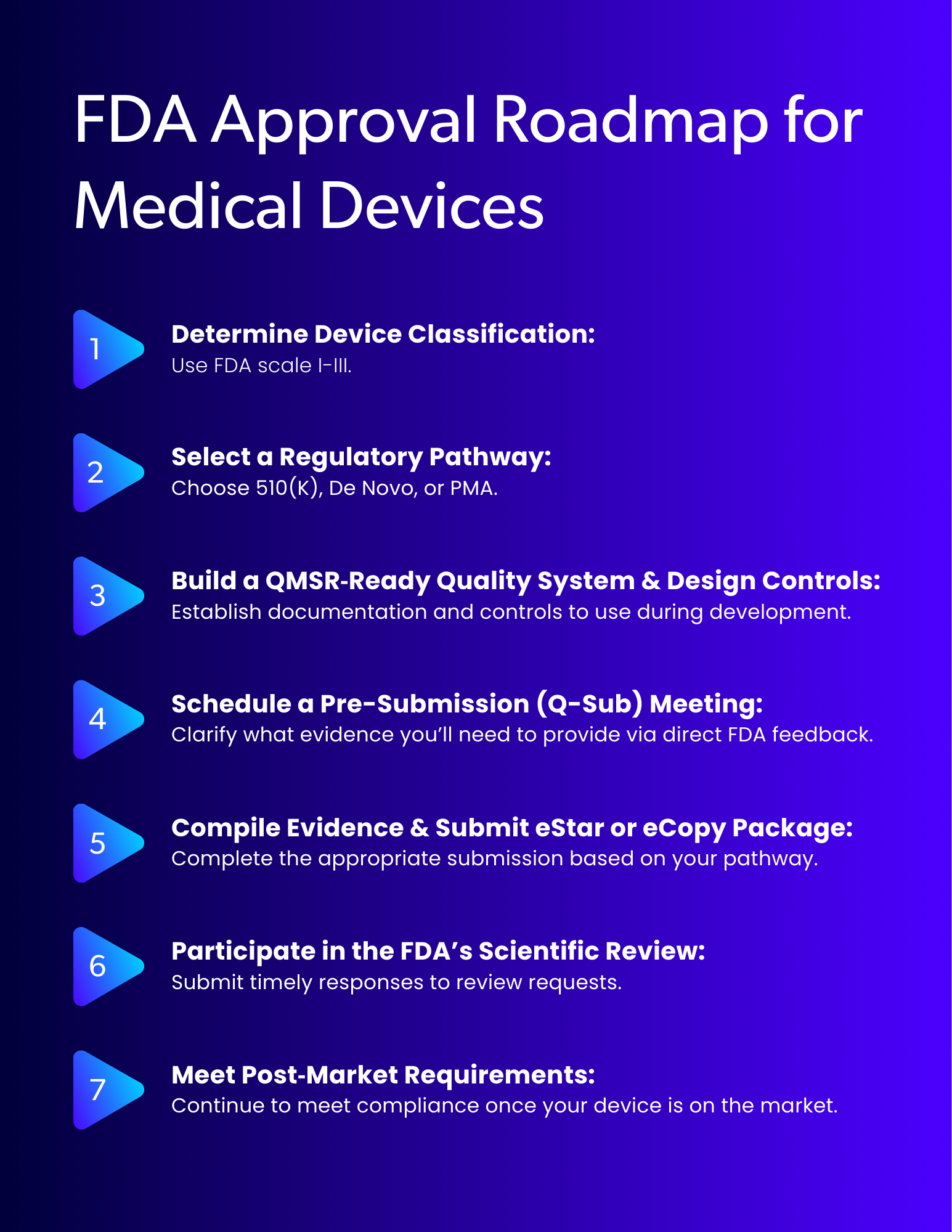
To secure authorization, manufacturers must follow a structured lifecycle approach that integrates safety, security, and documentation across the entire development process from concept to prototype.
1. Determine Device Classification
The first step in any regulatory strategy is to determine if your device is Class I (low risk), Class II (moderate risk), or Class III (high risk). This classification will dictate which submission pathway you follow and the evidence requirements you’ll need to satisfy.
Medical device technology companies should confirm classification early and revisit it whenever your device’s features, intended use, or claims change.
2. Select the Appropriate Regulatory Pathway
Selecting the correct submission pathway is critical for your timeline and budget. Here are the three paths and what each is used for:
Used when you can prove your device is "substantially equivalent" to a legally marketed predicate.
- Requirements: A structured and validated comparison showing technological characteristics, indications for use, and predicate performance tests.
- Timeline: Under MDUFA V (2025–2027), the FDA aims to review 95% of submissions within 90 days.
Used for low-to-moderate risk devices with no existing predicate.
- Requirements: A comprehensive risk and benefits profile plus a special controls proposal.
- Timeline: The FDA goal is 150 days, but typical approval often takes longer at eight to 14 months.
Used for Class III devices that are life sustaining, prevent impairment, or present potential risk of illness or injury.
- Requirements: Extensive clinical evidence to support device safety and effectiveness.
- Timeline: The FDA’s goal is roughly 285 days with recent 2024 data showing an average review time of approximately 290 days. This average is projected to continue into 2027.
3. Build a QMSR‑Ready Quality System and Design Controls
As of February 2026, the Quality Management System Regulation (QMSR) is fully effective. This new framework incorporates ISO 13485:2016 by reference but adds FDA‑specific expectations to avoid inconsistencies with other regulations and to ensure regulatory alignment across global markets. The rule includes clarifications around risk management integration, documentation alignment, and supplier oversight.
This step is where your medical device company lays the foundation for everything that will appear in its eSTAR submission. It is a crucial step because FDA reviewers will evaluate not only your test results, but also how you generated and controlled them.
Manufacturers will need to update procedures, retrain teams, and most importantly, ensure traceability from design inputs to verification and validation. Without clean, audit-ready reports that are mapped to both ISO 13485 and FDA’s additional requirements, it will be difficult if not impossible to achieve approval.
How to Build Quality System and Design Controls for Medical Devices
- Create (or update) your quality management system to meet QMSR standards.
- Implement full design and development controls
- Establish a risk management process for your entire development
- Ensure document control and record control systems are in place
- Confirm supplier and component controls
- Prepare documents for QMSR-aligned FDA inspection
4. Schedule a Pre-Submission (Q-Sub) Meeting
The Q‑Submission program is one of the most underused yet powerful tools available for FDA medical device approval. This meeting allows you to receive direct feedback from the FDA on your testing protocols before you submit.
A pre-sub meeting is especially useful for devices involving Software as a Medical Device (SaMD) or Artificial Intelligence and Machine Learning (AI/ML) components. You’ll be able to clarify what evidence you’ll need to present and prevent costly delays once you reach the formal review.
5. Compile Evidence and Submit Your eStar or eCopy Package
For 510(K) or De Novo submissions, you’ll follow the eStar submission steps. If you’re submitting for PMA approval, you’ll follow the eCopy process.
eStar Submission Steps
The FDA’s eSTAR template is the format used for preparing 510(k) and De Novo submissions. It includes embedded forms, validations, classification lookups, and structured templates to ensure your application meets technical screening requirements.
eSTAR submissions undergo a technical screening within approximately 15 days. If information is missing, the FDA will notify you and place your submission on hold until you provide a complete replacement. You have up to 180 days to resolve deficiencies before the submission is considered withdrawn.
How to Submit an FDA eStar Package:
- Download and complete eStar template
- Attach all required documentation inside the PDF
- Validate the package using automated eStar checks
- Submit through the CDRH Portal and pay user fees
- Respond to the FDA’s 15-day technical screening
eCopy Submission Steps
To submit a PMA approval request, you use the eCopy format. This process involves providing a digital version of your application on a physical medium (such as a CD or flash drive) that meets specific FDA formatting and technical standards to ensure it can be processed through the agency’s electronic systems.
If invalid, the FDA issues a hold letter and grants 180 days to correct issues before submission is withdrawn.
How to Submit an FDA eCopy Application:
- Prepare the PMA application (paper/master)
- Build the eCopy using the FDA’s technical standards
- Run validation using the FDA’s eCopy Validation Module
- Submit your PMA package to the FDA’s Document Control Center (DCC)
- Respond to the FDA acknowledgement and screening
6. Participate in the FDA’s Scientific Review
Once a submission passes a technical screening, the FDA begins scientific review. Under the Medical Device User Fee Amendments (MDUFA), the FDA targets approximately:
- 90 days for most 510(k)s
- 8–14 months for De Novo reviews
- One year + for PMAs depending on the scope of clinical evidence and advisory panel involvement
During this period, stay active in review cycles and submit timely responses as needed to keep your approval process moving forward.
7. Receive Authorization and Meet Post‑Market Requirements
After authorization, you will need to comply with post-market requirements throughout your product’s lifecycle. Many of these obligations such as Unique Device Identification (UDI), Global Unique Device Identification Database (GUIDI), complaint handling, Medical Device Reporting (MDR), and manufacturing controls apply equally across all pathways. Others like Corrective and Preventive Action (CAPA), depend on device risk and regulatory classification.
This table walks through what authorization looks like for each pathway and what post‑market requirements apply once your device is on the market:
FDA Post-Approval Table
| Pathway | FDA Decision Type | Market Status | Post-Market Obligations |
| 510(K) | Clearance | Device is “cleared” as substantially equivalent | UDI/GUDID, MDR, QMSR compliance, complaint/CAPA, possible special controls if based on a De Novo predicate |
| De Novo | Classification Order (Class I or II) | Device is legally marketed and becomes the first predicate in its class | UDI/GUDID, MDR, QMSR compliance, mandatory special controls, future modifications often require 510(k) |
| PMA | Approval | Device is fully “approved” and must comply with PMA conditions | UDI/GUDID, MDR, QMSR, annual reports, post approval studies, supplements for modifications |
Back to top
5 Common FDA Compliance Pitfalls and How Perforce Solves Them
Incomplete submissions, test errors, unresolved issues, and more can lead to significant delays and missed market opportunities. Below are five common pitfalls that are preventable using a dedicated Application Lifecycle Management (ALM) solution.
1. Incomplete or Inaccurate Documentation
Manual documentation processes are prone to human error. Excel spreadsheets are difficult to share across large teams and result in disconnected data, missed requirements, and inconsistent records.
Solution: Perforce ALM functions as a single, complete source of truth that tracks and stores all requirements, tests, and issues along with their change history.
2. Lack of Traceability
Failure to establish and maintain clear traceability between user needs, design inputs, design outputs, verification, and validation activities can leave major compliance gaps.
Solution: Perforce ALM offers full upstream and downstream traceability to create unbreakable links between requirements, code, tests, and risks.
3. Inefficient Change Management
With complex device design, changes are inevitable. However, poorly managed updates can ripple through the project and lead to scope creep, outdated test cases, and a final product that no longer aligns with its initial requirements.
Solution: Perforce ALM automates the process so that when a requirement changes, you instantly see the impact on downstream test cases and any other project element impacted.
4. Siloed Development Across Teams
When engineering, testing, and quality teams operate in separate systems, communication breaks down. This results in misaligned efforts, redundant work, and critical defects.
Solution: In Perforce ALM, everyone works from the same document. Granular permissions streamline dev cycles by granting users access to only the work they need.
5. Failure to Prove Risk Mitigation
Regulators require robust evidence that all identified risks have been systematically analyzed, controlled, and monitored.
Solution: Perforce ALM automatically provides detailed reporting and traceability matrices to satisfy all compliance needs.
Professional Services
In addition to our software features, Perforce offers dedicated ALM Professional Services to support teams navigating complex FDA workflows. Get professional guidance implementing, configuring, and monitoring your platform.
Back to top
Close the Loop on Medical Device Risk
FDA authorization requires strategic planning, process maturity, and deep alignment with evolving digital submission and quality expectations. With eSTAR, eCopy, QMSR, and other mandates in effect for FDA approval, medical device teams must modernize not only their documentation practices but their entire product development process.
See how Perforce ALM supports design control and traceability to significantly improve the efficiency, predictability, and quality of your medical device submissions.
You can also see how Perforce ALM compares against the competition:
Back to topMore Resources on FDA & Medical Devices
FDA Design Controls: Medical Device Developer Guide
FDA Compliance and Medical Device Development Process
⚕️ Biotech company Fractyl Health achieved CE mark certification 12 months ahead of schedule.
Learn how they did it. >>