
What is a Requirements Traceability Matrix (RTM)?
A requirements traceability matrix is a tool or document that maps the relationship between requirements and other artifacts like tests, issues, and source code. It serves as critical proof that all specified requirements have been successfully fulfilled and meet quality assurance and regulatory compliance.
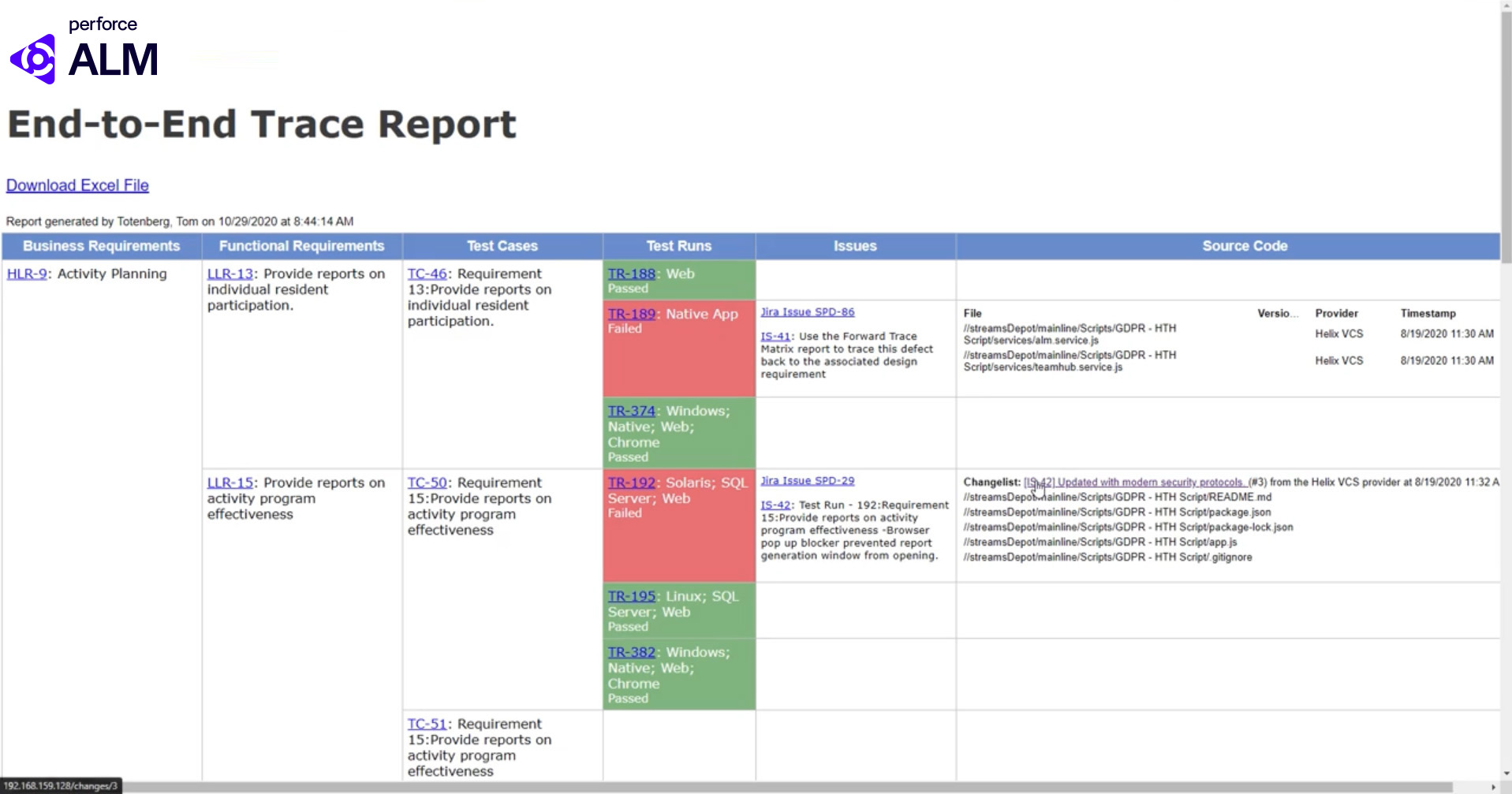
Read along or jump to the section that interests you most:
- Traceability Defined
- 5 Benefits of Using a Traceability Matrix
- How to Create a Traceability Matrix
- Specialized Matrices for Compliance and Risk
- Getting Started with Traceability Software
Traceability Defined
Requirements traceability is the process of tracking requirements throughout the entire development lifecycle and connecting them to all dependent artifacts. The result is clear, audit-ready paths from initial business objective to final implementation and validation.
Achieving Bidirectional Traceability
Bidirectional traceability is the ability to trace forward (e.g., from requirement to test case to defect) and backward (e.g., from defect to test result to requirement).
This two-way visibility matters for:
- Impact Analysis: Quickly assess how a change to one requirement will affect other elements of the project.
- Validation: Confirm that every requirement is linked to a successful test case.
- Root Cause Analysis: Easily trace defects back to the specific requirements that are impacted and/or to the code that caused them.

5 Key Benefits of Using a Traceability Matrix
1. Meet Goals Faster and Streamline Audits
A requirements traceability matrix (RTM) ensures that your requirements fulfill your original project goals and meet compliance requirements for all relevant regulations. For teams in regulated industries like aerospace, automotive, and medical devices, an RTM provides the documented proof needed to demonstrate compliance with standards like DO-178C, ISO 26262, or FDA regulations.
2. Ensure Complete Test Coverage
Requirement traceability helps your quality assurance (QA) team understand exactly what needs to be tested. By mapping every requirement to a specific test case, with bidirectional traceability, you guarantee comprehensive testing and ensure product quality.
3. Simplify Impact Analysis and Decision Making
As requirements change, an RTM gives you a clear view of all impacted artifacts. This automated traceability allows you to accurately assess the impact of the changes on your product design, timeline, budget, and resources for faster, clearer decision making.
[👉🏼 WHITE PAPER: ANALYZING THE IMPACT OF REQUIREMENTS CHANGE]
4. Manage Projects with Greater Visibility
RTMs provide real-time snapshots of project progress. All stakeholders can view which requirements have been implemented, tested, and passed. You’ll know exactly how far you’ve progressed and where you need to focus.
5. Mitigate Risk
A traceability matrix is invaluable for identifying gaps, inconsistencies, or high-risk areas early in a project. This proactive approach to risk mitigation saves time and money and ensures a higher quality end product.
The Pitfall of Weak Traceability
The benefits of comprehensive requirement traceability are clear, but what happens when you have weak traceability? Weak traceability can make it difficult to meet goals, run the right tests, make decisions, and manage your projects. Learn more:
[📄 WHITE PAPER: RECOGNIZING THE DANGER SIGNS OF WEAK TRACEABILITY]
Back to top
How to Create a Requirements Traceability Matrix
While creating an RTM can be done manually in spreadsheets like Excel, this approach quickly buckles under the weight of complex projects. A dedicated tool like Perforce ALM automates the process for a more accurate, efficient, and dependable development process.
8 Steps to Create an RTM
- Define Your Traceability Goals: Determine what you need to track (proving compliance, managing risk, ensuring full test coverage, etc.). Your goals will define the scope of your matrix.
- Gather Your Artifacts: Collect all your project artifacts, including business requirements, functional requirements, non-functional requirements, design documents, test cases, and risk assessments.
- Establish Traceability Links: Connect the artifacts. Link each requirement to its corresponding design specifications, test cases, and source code. This is where a dedicated ALM tool provides the most value by creating these links automatically as you work.
- Include Regulatory Metadata: Attach metadata around compliance, including references, priority, ownership, status and verification.
- Generate and Maintain the Matrix: Run a report to generate your RTM. This matrix should be a living document that is updated continuously as the project progresses and artifacts change.
- Update the Matrix: To ensure your data is always accurate and complete, enforce CI/CD and change management policies.
- Integrate Your Toolchain: Make sure your test management tools, issue trackers, and data management applications are integrated with your matrix.
- Generate Reports and Conduct Audits: Regular reviews and traceability audits keep links up-to-date and accurate and ensure that change logs support compliance.
For complete instructions on creating and maintaining a traceability matrix, see our blog:
How to Create a Traceability Matrix

Specialized Matrices for Compliance and Risk
Compliance Matrix
A compliance matrix is a tailored RTM focused on meeting regulatory standards. It maps each clause from a regulation (like ISO 26262) directly to your project's requirements and the test cases that verify them. This provides auditors with a clear, direct line of evidence that your product is compliant.
Perforce ALM Achieves ISO 26262 Compliance

Risk Matrix
A risk matrix proactively manages your project’s risks. By linking potential risks to requirements, you can ensure that you design, implement, and test effective mitigation measures. You can use this matrix to conduct risk analyses like FMEA (Failure Modes and Effects Analysis) and to demonstrate adherence to safety standards. Also, use it to calculate a risk priority number (RPN) that demonstrates severity and probability of potential risks.
Watch the video to learn more:
How to Manage Risk Using Traceability
Back to top
Getting Started with Traceability Software
With a traceability solution like Perforce ALM, you can go beyond static matrices and achieve visible traceability across your entire development lifecycle. Every time you create a test case from a requirement or log an issue from a failed test, traceability links are automatically established — no manual effort required.
From there, you can:
- Visualize relationships between requirements, tests, and issues in real time
- Generate up-to-date traceability matrices with a single click
- Integrate with Jira to manage issues seamlessly
Want to see how visual traceability works in practice?
Watch the webinar: Visual Traceability in Perforce ALM
Try Perforce ALM for End-to-End Traceability
Ditch the spreadsheets and see for yourself how easy it is to create a traceability matrix with end-to-end traceability across your product’s lifecycle. Watch the product demo and then try it for free for 30 days.