Blog
May 15, 2026
7 Challenges Delivering Secure Aerospace Software in the Age of AI (with Solutions)

Application Lifecycle Management,
Data Management,
Digital Creation & Collaboration,
Security & Compliance
The challenge of any aerospace company is to deliver new capabilities without compromising safety, reliability, or precision.
At our current juncture, legacy technology runs into conflict with modern tool stacks. Artificial intelligence (AI) creates fissures in compliance and auditability, and innovation and productivity gains come at a cost of greater complexity. Despite these seismic shifts, the central question remains the same:
How do you prove every requirement is met, every change is controlled and tracked, and every release can be reproduced long after a program ships?
This guide provides a blueprint for modernized workflows that expedite aerospace development while preserving trust in the digital thread. It addresses the top seven aerospace challenges that teams face today by dissecting each challenge, examining real-world impacts, and offering clear software-based solutions.
Additional Resource: Aerospace Solutions from Perforce
Back to topThe State of Aerospace Software Development
The aerospace and defense industries operate with unique constraints where stakes are high and consequences can be catastrophic. Products with millions of lines of code must meet the world’s most stringent regulations and function flawlessly for 20 to 40 years in demanding conditions.
According to the Perforce 2025 State of Aerospace and Defense Software Development Report, the biggest developmental obstacles cited by respondents when meeting safety, security, and other issues include:
- Time consuming testing
- Tool qualification for compliance
- Source code management, including complex branching and traceability
- Managing assets across both hardware and software
- Unauthorized access to onboard/off-board systems
- Lack of skilled workforce
To complicate things, over half of companies that responded are now incorporating AI into product design. Meeting these challenges will require updated workflows and a suite of modern DevOps tools that includes:
- Version control (Perforce P4) to manage massive sets of files and facilitate secure collaboration across teams.
- Requirements management (Perforce ALM) to ensure traceability throughout development cycles.
- IP governance (Perforce IPLM) to bridge software and hardware development and manage IP release and reuse efficiently.
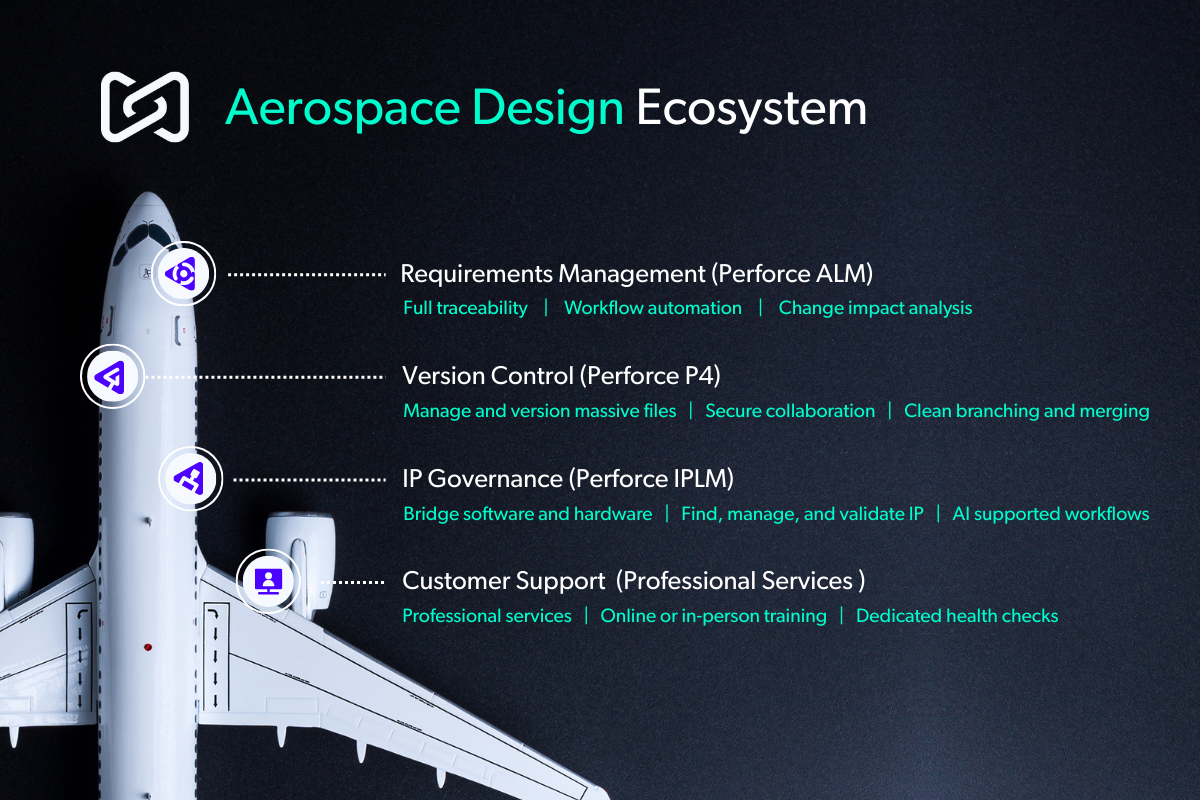
Let’s look more closely at the top aerospace challenges and how to meet them using this tool stack.
Back to topChallenge 1: Managing Complexity and Scale in Safety Critical Systems
The Industry Challenge
Modern aircraft are software-defined machines. Avionics, flight control systems, and autonomous operations all depend on millions of lines of code working in perfect harmony with complex hardware. Complexity arises in:
- Meeting safety standards like DO-178C, DO-254, and ARP4754A
- Long product lifecycles spanning decades
- Multi-tier global supply chains with hundreds of suppliers
- Tool sprawl across engineering disciplines
- Legacy tools not designed for modern DevOps practices
Additionally, aerospace projects generate massive volumes of diverse data such as CAD models, firmware, source code, and test data that must be versioned and managed. Teams require secure data management platforms that can handle the size and scale of aerospace design files without slowing during branching and merging.
Real-World Impact
Boeing, one of the world's largest aerospace manufacturers, faced the challenge of maintaining version control across massive, complex codebases while ensuring every change could be traced and audited. With aircraft programs lasting decades and involving thousands of engineers, they needed a solution that could scale without sacrificing precision. Watch the video testimonial
The Perforce Solution
Perforce P4 (data management) provides the foundation for managing complex, safety-critical aerospace workflows:
| Feature | Description |
| Single source of truth | Manage all digital assets including source code, models, test data, and documentation |
| Handles massive scale | Deliver high performance when working with millions of files and large binaries (CAD models, simulation data, firmware images) |
| Branching and merging | Support long-lived variants for different aircraft programs, upgrades, and retrofits |
| Immutable history | Provides long-term auditability with timestamps, authors, and reasons for changes so that exact historical builds can be reproduced later |
Boeing uses Perforce so that every team member has complete visibility into version history without guesswork. As their team noted, addressing quick changes is easy with full version history and intuitive branching.
Challenge 2: Traceability to Meet Aerospace Compliance
The Industry Challenge
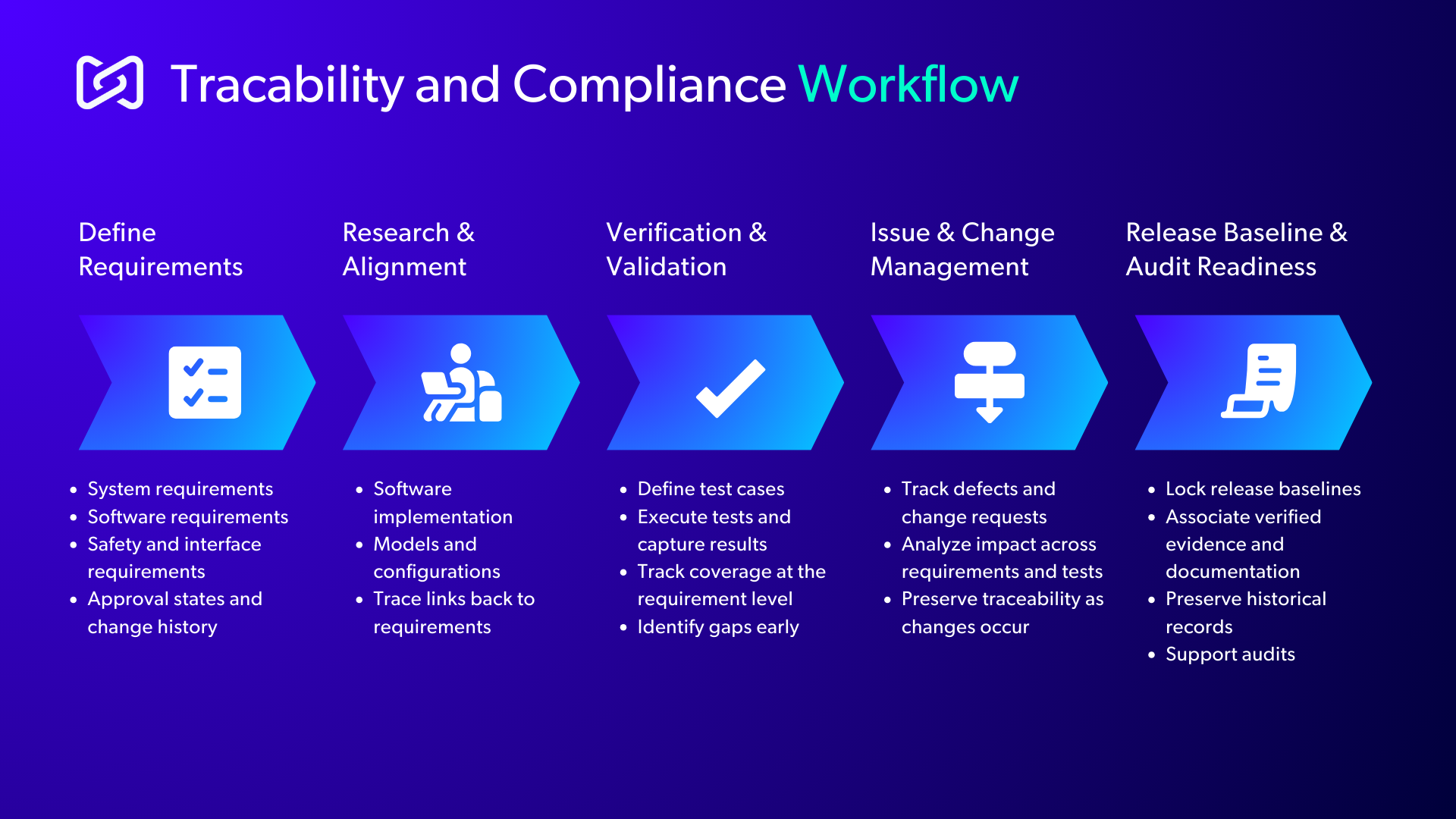
Aerospace regulations demand end-to-end traceability from requirements through code to tests and defects. To address these complex development cycles, teams need a tech stack that features stringent requirements management that is backed by secure data management and IP governance. Yet many organizations still rely on manual traceability matrices and spreadsheets. Using this approach, you risk missing links between requirements and test cases that can take days or weeks to trace with disconnected tools. Teams must also handle growing use of AI components and model-based design while keeping the certification narrative clear.
Real-World Impact
EuroAvionics develops mission planning and weight-and-balance software for emergency aircraft such as police helicopters and air ambulances. Operating in a DO-178B regulatory environment, they use Perforce ALM to demonstrate complete traceability from change requests through requirements, design, implementation, testing, and delivery, with signoffs at every stage.Read the Case Study
The Perforce Solution
Perforce ALM (requirements, test, issue management) delivers built-in traceability for aerospace compliance:
| Feature | Description |
| Bi-directional traceability | Automatically links requirements to tests, issues, and releases |
| Built-in support | Quickly meet standards like DO-178C and ARP4754A |
| Real-time traceability matrices | Automated with no manual linking or spreadsheet maintenance |
| Change impact analysis | Instantly see downstream effects of safety-critical updates |
| Workflow automation | Includes electronic signatures and approval gates |
| Reporting Platform | Allows for custom queries and reports for regulatory submissions |
EuroAvionics uses Perforce ALM throughout their development process. Engineering Manager Martin Beeby explains:
Back to top"With ALM's reporting platform, we can dump project data into a relational database and query the database to get exactly the reports we need ready for publishing."
Challenge 3: Bridging Systems, Software, and Hardware
The Industry Challenge
Fragmentation is the enemy of efficiency. As the bridge between hardware and software development becomes shorter, systems engineers, software developers, and hardware designers need tools that connect the digital thread from concept to production across all silos.
Without a clear collaboration strategy, it is difficult to trace system requirements bi-directionally through detailed design, implementation, and verification stages. The result is a clunky pipeline that is fraught with developmental risks.
Real-World Impact
Modern aircraft programs like the Boeing 787 or Airbus A350 involve thousands of engineers across multiple continents, working on interdependent systems. A single change to flight control software might impact avionics displays, structural load calculations, and maintenance procedures. Without a unified view, these dependencies often remain hidden until integration testing. Unfortunately, by this point, time is lost and fixes are more expensive.
The Perforce Solution
Perforce IPLM (IP Lifecycle Management) bridges the gap between systems, software, and hardware through an IP-centric view of design:
| Feature | Description |
| Unified environment | Links system models, requirements, software, and hardware data as IPs |
| Configuration management | Manages configurations and variants across complex products and platforms |
| True digital thread | Unified platform from concept through certification to production |
| MBSE support | Connects high-level system models to implementation details with comprehensive metadata management |
| IP reuse and security | Enables workflows to ensure that IPs are qualified and secure before they can be used |
| Design verification traceability | Provides design verification traceability for DO-254 compliance |
By connecting disparate engineering disciplines, Perforce IPLM (supported by P4) eliminates data silos and provides visibility across your entire product lifecycle. Track design changes from their system-level origins through implementation and testing for full compliance traceability.
Side Note: AI in Aerospace Development
Artificial intelligence can speed up development, but AI-driven insight is only as useful as the integrity of the underlying lifecycle and configuration data. The Perforce IPLM partnership with Siemens EDA tools powers software-defined, AI-powered product development that safely integrates artificial intelligence into workflows without losing traceability.
Read the eBook: Unifying Software and Semiconductor Development
Back to topChallenge 4: Overseeing Variants and Programs Across Long Lifecycles
The Industry Challenge
Aerospace programs rarely develop a single product. Instead, they create families of variants such as engine configurations, mission-specific avionics packages, and regional customizations. Each variant must be developed in parallel, with changes to the baseline flowing selectively to derivatives.
Complicating matters, aerospace products have extraordinarily long lifecycles. A commercial aircraft might remain in service for 30 years. During that period, it may need periodic engineering, upgrades, and retrofits. Configuration drift across programs becomes a serious risk when teams lose track of which changes apply to which variants.
Real-World Impact
The Swedish Space Corporation (SSC) launches sounding rockets and stratospheric balloons, using complex software across OpenVMS, Windows, and Linux environments. With monthly release cycles and mission-critical deadlines, they needed version control that could handle diverse platforms while maintaining stability over the long term.
The Perforce Solution
The combination of Perforce P4, ALM, and IPLM provides full developmental lifecycle management:
| Feature | Description |
| P4 branching strategies | Support long-lived variants with efficient merging and conflict resolution |
| IPLM configuration and variant management | Tracks which components go into which variants |
| ALM traceability | Ensures nothing is lost over time across programs and releases |
| Labels and baselines | IPLM immutable and hierarchical releases along with ALM baselines and P4 changelists ensure reproducibility for decades |
| Immutable history | Provides a complete audit trail from initial development through decades of maintenance |
This approach provides aerospace organizations with a scalable solution to maintain multiple product lines simultaneously, support legacy platforms, and develop next-generation systems while keeping compliance top of mind.
Back to topChallenge 5: Security and Collaboration Across the Aerospace Supply Chain
The Industry Challenge
Aerospace supply chains are vast and complex. OEMs work with Tier 1 suppliers, who in turn work with Tier 2 and Tier 3 suppliers. The resulting web of dependencies can span multiple countries and security domains, elevating the risk of export control violations, IP theft or “leakage,” unauthorized modifications, and version mismatches.
To keep development on track, suppliers need secure access to specifications, interface definitions, and test data. Without visibility into supplier changes, teams may discover incompatibilities late in the process when fixes are expensive and schedule impacts are severe.
Real-World Impact
A typical commercial aircraft contains components from hundreds of suppliers. The engines alone might involve dozens of companies contributing designs, manufacturing processes, and software. Coordinating these efforts while protecting proprietary information and maintaining audit-ready change history is a monumental challenge.
The Perforce Solution
P4 provides secure supply chain collaboration:
| Feature | Description |
| Role-based access | Depot segmentation allows granular permissions by partner, folder, or even individual file |
| Controlled data sharing | Avoids duplication using proxy servers and replicas |
| Network IP address access control | Restricts access by location |
| End-to-end traceability | Provides traceability across organizational boundaries |
| Audit-ready change history | Immutable logs of who changed what, when, and why |
| Data encryption | Secures all replicated repositories and depots |
Suppliers can access exactly what they need with changes tracked across the entire supply chain.
In addition, Perforce IPLM features strict geofencing guardrails. Protect valuable property and prevent IP leaks by restricting access across geographical borders.
Challenge 6: Digital Transformation and Model-Based Systems Engineering
The Industry Challenge
Digital twins, model-based systems engineering (MBSE), DevSecOps for safety-critical systems, and data-driven decision-making are changing how aerospace design cycles spin. While these initiatives promise faster development, better quality, and reduced costs, they also introduce new complexity and traceability challenges.
Digital twins, for instance, consume vast amounts of data from design, manufacturing, testing, and operations. Maintaining consistency between the digital twin and physical asset demands rigorous data management.
MBSE replaces document-centric systems engineering with executable models. While this approach improves project clarity, it also creates new artifacts that must be versioned, traced, and verified alongside traditional code and documentation.
Real-World Impact
According to recent aerospace industry trends, over half of aerospace developers now use AI in product design, with spending on AI expected to reach $44 billion by 2030. Cloud-based technologies are transforming design processes, with the U.S. Air Force reporting a 70% reduction in time to implement new ideas.
These technologies generate unprecedented volumes of data including simulation results, ML training datasets, and sensor telemetry. Legacy file systems and version control tools cannot operate at this scale.
The Perforce Solution
A complete Platform to drive digital transformation and grow with your organization as technology changes:
| Feature | Description |
| Perforce P4 | Serves as the backbone for digital engineering data, managing massive datasets for digital twins and simulations |
| Perforce ALM | Enables continuous validation and verification through automated testing and full traceability |
| Perforce IPLM | Supports digital thread continuity, from the initial concept all the way through to production |
| Static analysis tools (QAC and Klocwork) | Check for vulnerabilities and enforce coding standards like MISRA C/C++ and JSF AV C++ |
| CI/CD pipeline integration | Facilitates DevSecOps best practices |
| Cloud-based development support | Ensures development processes have security and compliance built in from the start |
These tools work together to support modern development practices while maintaining the safety, security, and compliance that aerospace applications demand.
Back to topChallenge 7: Skill Gaps and Talent Shortages
The Industry Challenge
The aerospace industry relies on highly specialized engineering talent to design, build, and maintain safety-critical systems. However, organizations currently face a severe deficit of well-trained designers and software engineers. As a generation of highly experienced engineers retires, they take decades of invaluable domain knowledge with them.
This talent shortage results in frustrating operational bottlenecks. New hires require extensive onboarding to understand complex regulatory frameworks, legacy codebases, and rigorous safety standards like DO-178C. When teams operate without adequate staffing or necessary expertise, innovation slows, certification risks increase, and project timelines inevitably slip.
Real-World Impact
A comprehensive McKinsey study examining how to maximize the return on talent in aerospace and defense highlights this crisis. Their research indicates that the industry faces significant hurdles in attracting and retaining critical digital and software engineering talent. Without closing these skill gaps, organizations risk severe delays in delivering next-generation aerospace systems.
The Perforce Solution
McKinsey’s top recommendation is to “Reimagine workflows via enhanced technology: build a foundation of tech-enabled, fast, and frictionless workflows and empower employees to drive transformation.” They also suggest companies nurture upskilling as part of their overall business strategy.
To aid companies in both ventures, Perforce provides a comprehensive ecosystem of technology and education. We offer expert guidance to help aerospace organizations overcome their talent shortages and maximize the output of their engineering teams through:
| Feature | Description |
| Robust training programs (Link) | New hires can master version control, traceability, and compliance at their own pace without draining senior engineering time |
| Professional services (Link) | Act as an extension of your engineering team to implement best practices, optimize your architecture, and build efficient workflows from day one |
| Customer support (Link) | Responsive support team provides immediate resolutions to keep your developers innovating rather than troubleshooting tool configurations |
| Automated workflows and compliance | By automating manual administrative tasks and built-in traceability, Perforce reduces the cognitive load on your engineers |
| Permanent knowledge retention | When senior personnel retire or move on, their historical decisions, code variants, and intellectual property remain securely captured and easily searchable for the next generation of engineers |
By combining industry-leading tools with exceptional support and training, Perforce empowers aerospace organizations to bridge the talent gap.
Back to topAerospace Design Solutions That Balance Precision and Efficiency
Meeting current developmental needs while planning for a quickly evolving technological future requires a toolset that modernizes aerospace design without sacrificing compliance-based traceability. Organizations need solutions that:
- Are reliable
- Satisfy compliance
- Scale with growing assets
- Secure sensitive data and IP
- Facilitate global collaboration
- Maintain digital thread continuity
- Offer continuous product support and training
Perforce makes an ideal partner for aerospace companies in growth mode. We’re dedicated to supporting your innovation not only through our digital tools, but through continuous support and training to help your teams excel in the face of shortages and talent gaps.
Talk to a Perforce expert today to learn how our solutions address your biggest roadblocks.